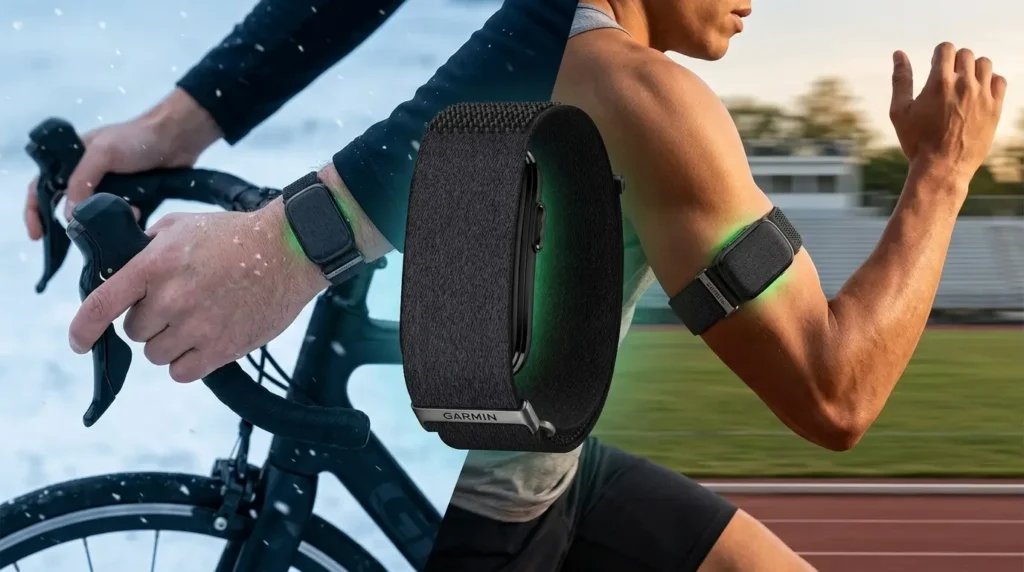
Your CIRQA readings do not match your effort, and you want to know whether the $59.99 upper arm band fixes it. The short answer is that placement matters enormously for a narrow set of activities and almost not at all for everything else.
Here is where each position actually wins, based on side-by-side testing of two CIRQA pods worn simultaneously against chest strap references.
Key Takeaways
- The upper arm band delivers chest-strap-level heart rate during running intervals and cold-weather rides, the two scenarios where the wrist collapses hardest.
- The wrist stays more accurate for sleep timing, since arm-worn sensors misread in-bed reading and scrolling as sleep by 10 to 20 minutes.
- Most CIRQA data loss is not a placement problem at all: missed automatic workout detection leaves you with no heart rate data regardless of where the pod sits.
Why placement changes optical readings
The CIRQA uses Garmin’s Elevate Gen4 optical sensor, the same module found across the current Forerunner and Venu lines. It fires green LEDs into the skin and reads the light that bounces back, inferring pulse from changes in blood volume.
That signal is fragile. Anything that moves the sensor relative to the skin, or lets ambient light under the pod, injects noise the algorithm has to guess its way through.
The wrist is the worst place on the arm for this. Tendons flex with every grip change, the joint deflects constantly, and the skin sits thin over bone.
The bicep is flatter, fleshier, and moves as one mass with the upper body. Less relative motion means a cleaner signal, which is why upper arm optical sensors have matched chest straps for years across every brand.
One more variable is specific to the CIRQA pod. The module is noticeably longer than a Whoop 5.0 pod, and on wrists under about 6.5 inches it overhangs the curve rather than sitting flat, which can break skin contact and let light leak in. Moving to the bicep removes that geometry problem entirely.
Where the bicep band wins
Three scenarios produce meaningful, repeatable failures on the wrist.
Running intervals. In 400m repeat sessions, the wrist-worn CIRQA missed most reps outright while a second CIRQA on the bicep of the same arm tracked the chest strap almost exactly. Swapping the two pods reproduced the result, ruling out a defective unit.
Cold outdoor cycling. On mixed road and gravel rides near 60°F with wind and rain, every wrist-worn band in the test drifted, CIRQA included. Vasoconstriction pulls blood away from the wrist capillaries and the sensor has less signal to work with.
Wrist-loaded strength work. Lat pulldowns, rows, and curls compress and flex the wrist under load. The wrist pod typically recovers within a minute or two, but the opening set is often wrong.
The bicep band is also the right call if you broadcast heart rate. CIRQA transmits over ANT+ and Bluetooth to an Edge computer, Zwift, a Peloton, or a gym treadmill, and upper arm placement gets that stream to chest strap quality. That capability is part of why the CIRQA reads differently than subscription-based rivals in a head-to-head against the Whoop 5.0.
Garmin’s own band is the best-executed part of this. The fabric stretches more than Whoop’s equivalent, which prevents the pod from flipping over mid-session, a documented annoyance on competing arm sleeves.
Where the wrist is good enough
For most of what a screenless tracker does, the wrist is fine and often better.
Sleep is the clearest case. Testing across weeks showed arm-worn pods offsetting sleep start and end times by roughly 10 to 20 minutes, because reading or scrolling in bed does not move the bicep enough to register as awake. The wrist catches that motion.
Steady-state work is also a non-issue. Indoor trainer rides, easy runs, warm-weather road rides, yoga, and general gym sessions all tracked cleanly on the wrist against chest strap references.
Daily step counting is effectively a tie. In a controlled 500-step walk, the wrist pod logged 509 and the bicep pod logged 520, a spread small enough to ignore.
| Scenario | Wrist | Upper arm |
|---|---|---|
| Running intervals | Frequent misses | Chest strap level |
| Cold outdoor cycling | Drifts badly | Reliable |
| Indoor trainer, steady runs | Accurate | Accurate |
| Wrist-loaded strength | Slow to lock on | Good, minor curl errors |
| Sleep start and end times | Accurate | Off by 10 to 20 min |
| Daily steps | 509 per 500 | 520 per 500 |
| Automatic rep counting | Enabled | Disabled by Garmin |
| HR broadcast quality | Adequate | Best available |
What breaks accuracy for everyone
Some failure modes follow you to either position.
- Cold skin. Below roughly 40°F, peripheral vasoconstriction weakens the optical signal at any site. The bicep suffers less because it is usually under a sleeve.
- Dark tattoo ink. Black, dark green, and dark blue pigment absorb the same green wavelength the sensor reads. This is physics, not a Garmin defect, and it affects every optical wearable equally.
- Loose fit. A strap you can slide freely lets the pod rock and admits ambient light. Snug enough to stay put, loose enough not to leave a mark, is the target.
- Cadence lock. When arm swing frequency happens to match a plausible heart rate, the algorithm can latch onto the wrong number and hold it for minutes.
The largest source of missing data is separate from all of this. The CIRQA runs its sensor at reduced power until it believes a workout has started, so an undetected or prematurely ended activity leaves a permanent hole in your heart rate record that no amount of retroactive editing fills. That constraint sits alongside the other structural limits of the CIRQA platform.
Setting up the band correctly
Buying the band is not enough. The CIRQA has no automatic placement detection, so an unconfigured pod on your bicep is running wrist-tuned algorithms.
- Open Garmin Connect, select the CIRQA device, and set the global wear position to upper arm.
- Set position per sport profile as well. Each activity type carries its own setting, so a profile configured for weightlifting on the bicep will override your default.
- Position the pod over the outer bicep on the flat plane, not on the muscle crest and not down toward the elbow crease.
- Tighten until the band does not shift when you flex, then back off one notch.
- Start demanding sessions manually with the side button rather than trusting automatic detection.
Two practical notes. Switching between the wrist and arm bands uses spring pins that rotate awkwardly inside the fabric, so this is not a swap you will want to do daily.
And the arm band comes in S/M and L/XL for $59.99. If you already own a Whoop 4.0 bicep sleeve, the CIRQA pod drops into it without modification, which saves the accessory purchase entirely.
FAQ
It depends entirely on your training. If you run intervals, ride outdoors in cool weather, or broadcast heart rate to a bike computer or gym equipment, it is the single highest-value CIRQA accessory and it eliminates the device’s worst failure mode. If you mostly walk, sleep, lift, and do steady cardio, the included wristband already gives you accurate data and the band adds nothing.
Yes, and moving the band is the only real fix. Dark ink absorbs the green light the sensor depends on, producing erratic numbers or none at all over heavily tattooed skin. Garmin acknowledges this in support documentation, and the limitation applies to every optical wearable on the market. If your wrist is inked but your upper arm is not, the arm band solves the problem outright.
Interval work combines the two things optical sensors handle worst: rapid heart rate swings and high-frequency arm motion. The algorithm smooths aggressively to reject noise, so a 30-second spike to 175 bpm can be filtered into a gradual climb that never arrives. Independent testing by Ray Maker of DC Rainmaker showed the wrist pod missing nearly every rep in 400m sessions while a bicep pod on the same arm matched the chest strap.
Yes. Cold is the strongest argument for the arm band. When surface blood flow drops at the wrist, the sensor loses signal quality even with a perfect fit, and results degrade further with wind and rain exposure. The upper arm typically sits under a sleeve or jacket, staying warmer and better perfused for the entire session.