Key Takeaways
- World-Class Performance in a Compact Form Factor: 1 PetaFLOP of AI compute power in FP4 format, capable of running models with up to 200 billion parameters locally.
- Unified Memory Without Bottlenecks: 128 GB of LPDDR5x shared between CPU and GPU via NVLink-C2C, eliminating the traditional fragmentation that limits LLM processing.
- Ready-to-Use Enterprise Software Ecosystem: Pre-installed DGX OS featuring NVIDIA NIM, RAPIDS, and native support for PyTorch, TensorFlow, and Jupyter.
The Problem It Resolves
Training and fine-tuning models in the cloud incurs two distinct costs: financial and privacy-related. Compute invoices can reach thousands of dollars monthly, and sensitive data often travels to infrastructures beyond an organization’s direct control.
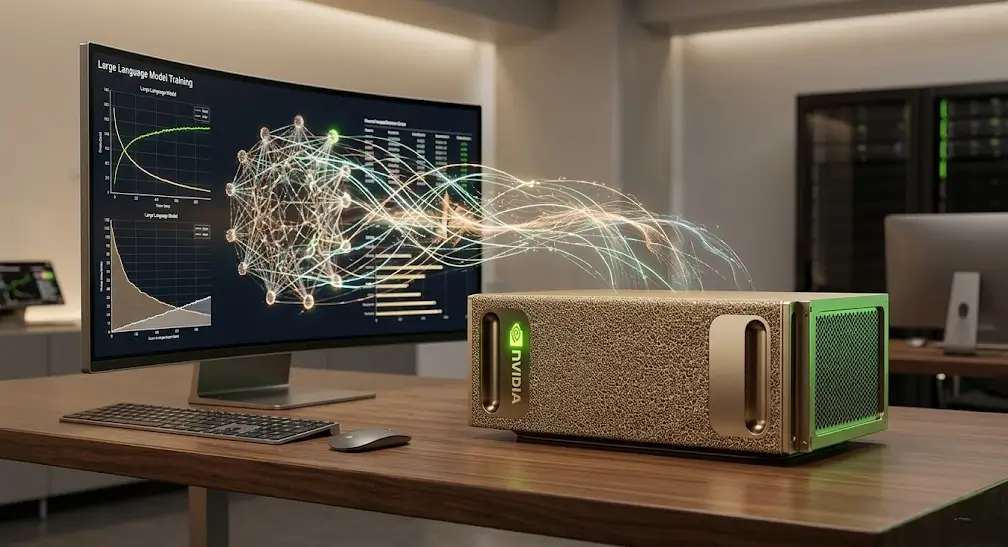
The NVIDIA DGX Spark addresses this friction with a radical approach: bringing the Blackwell architecture—previously exclusive to data centers—to a device roughly the size of a Mac Mini. As analyzed in the transition toward local AI, the demand for technological sovereignty is redefining which hardware is considered strategic for enterprises and development teams.
The Lineage: From DGX-1 to the Desktop
In 2016, Jensen Huang personally delivered the first DGX-1 to the founders of OpenAI. That machine marked the dawn of the modern AI era and eventually paved the way for ChatGPT. However, it was rack-mounted hardware: expensive, bulky, and requiring industrial-grade cooling.
The DGX Spark (formerly known as Project DIGITS) is the solution to that same original challenge, stripped of logistical barriers. The result is a 1.2 kg unit with personal supercomputer capabilities.
GB10 Architecture: The Superchip Powering the System
The core of the NVIDIA DGX Spark is the NVIDIA GB10 Grace Blackwell superchip. It integrates a 20-core ARM CPU (10 Cortex-X925 + 10 Cortex-A725) and a Blackwell GPU on a single substrate, connected via NVLink-C2C.
This interconnect is a critical architectural feature: it delivers bandwidth five times higher than PCIe 5.0, eliminating the classic bottleneck between the processor and the graphics card. The entire 128 GB LPDDR5x memory pool is coherently accessible by both units. No partitions. No high-latency transfers.
Technical Specifications
| Specification | Detail |
| CPU | 20 ARM Cores (10 X925 + 10 A725) |
| GPU | Blackwell, 5th Gen Tensor Cores |
| AI Performance | 1 PetaFLOP (FP4) |
| Memory | 128 GB Coherent LPDDR5x |
| Bandwidth | 273 GB/s |
| Storage | 4 TB NVMe with SED encryption |
| Networking | 10GbE + ConnectX-7 (200 Gbps) |
| Wireless | Wi-Fi 7 + Bluetooth 5.4 |
| Dimensions | 150 x 150 x 50.5 mm |
| Max Power Consumption | 240W |
Impact of the FP4 Format
The Blackwell architecture introduces native support for 4-bit precision (FP4). The practical consequences are twofold:
- Models are compressed by up to 70% without significant loss in accuracy.
- A single unit can execute inference on models up to 200B parameters, and perform fine-tuning on models up to 70B, including Llama 3 or Qwen using local data.
This represents the exact shift discussed when analyzing post-2026 architectures: AI compute is becoming specialized, miniaturized, and migrating toward the edge.
Software: Full Stack from First Boot
The system ships with NVIDIA DGX OS (Ubuntu 24.04) optimized for Blackwell. It includes:
- NVIDIA NIM: Inference microservices that maximize performance on local hardware.
- NVIDIA RAPIDS: Data science workflows executed directly on the GPU.
- Standard Frameworks: PyTorch, TensorFlow, and Jupyter, with transparent acceleration.
The value proposition is “plug-and-play” for researchers. No driver configuration or manual stack tuning is required.
Real-World Use Cases
- Robotics and Autonomous Agents: Integrated with systems like Hugging Face’s Reachy Mini, the DGX Spark processes computer vision and natural language in milliseconds without network latency.
- Healthcare and Research: Patient data never leaves the lab. Diagnostic imaging models and genomic analysis are executed with power previously found only in the cloud.
- Content Creation: Comparative benchmarks show video and 3D asset generation up to 8 times faster than a MacBook Pro M4 Max. The comparison with Apple is intentional, considering the architectural shift between M4 and Snapdragon X Elite defining the premium segment.
- Gaming (Capable, though not the primary design): The system runs Cyberpunk 2077 at 175 FPS in 1080p with DLSS and Ray Tracing enabled. The efficiency used for AI tensors translates into raw graphical throughput—unsurprising given the context of DLSS 5 and generative photorealism.
Modular Scalability
Two DGX Spark units connected via ConnectX-7 cable effectively double the capacity:
| Configuration | Max Inference | Fine-Tuning | Total Power |
| 1 Unit | 200B Parameters | 70B Parameters | 1 PetaFLOP |
| 2 Units | 405B Parameters | ~140B Parameters | 2 PetaFLOPs |
A team can begin with a single unit and scale without migrating platforms.
Competitive Positioning
Apple competes in this space with the M4 lineup and unified memory. However, the DGX Spark operates in a different category: the NVIDIA software ecosystem, native FP4 support, and 128 GB of coherent memory for intensive AI workloads have no direct equivalent.
Standard workstations with RTX GPUs face the structural limit of VRAM-RAM fragmentation. The DGX Spark eliminates this by design. NVIDIA’s consolidation as global critical infrastructure is further explored in our analysis of why NVIDIA is the new global benchmark.
Implementation Considerations
The system can generate significant thermal output under extreme, prolonged loads, as noted by analysts like John Carmack in endurance testing. At 240W within a 15 cm chassis, environmental ventilation is critical. While NVIDIA includes advanced internal cooling, maintaining adequate airflow remains the user’s responsibility to sustain peak performance.
ROI: The Calculation That Changes the Equation
The price range for the DGX Spark fluctuates between $3,000 and $4,700, depending on the manufacturer and storage configuration. Compared to the monthly cost of cloud compute for fine-tuning large models, the break-even point is reached in months, not years.
Iteration latency is reduced. Data stays on-premises. Development velocity increases. In a market where the collapse of the AI freemium model makes external dependencies increasingly expensive, owning the hardware is a strategic advantage.
Frequently Asked Questions
AI developers, data scientists, academic researchers, and advanced students who need to prototype, fine-tune, and run models locally without relying on remote infrastructure.
The system comes optimized with DGX OS (Ubuntu 24.04), the industry standard for AI development. Changing the OS breaks the NVIDIA stack optimizations and reduces the effective performance of the Blackwell GPU.
In normal use, it is comparable to a high-end desktop. Under intense AI workloads, the cooling system increases its velocity. It is designed for office and laboratory environments, not a server rack.
Yes. Through NVIDIA NIM and libraries like llama.cpp, the system delivers up to 35% higher performance in next-generation LLMs compared to systems not optimized for Blackwell.