
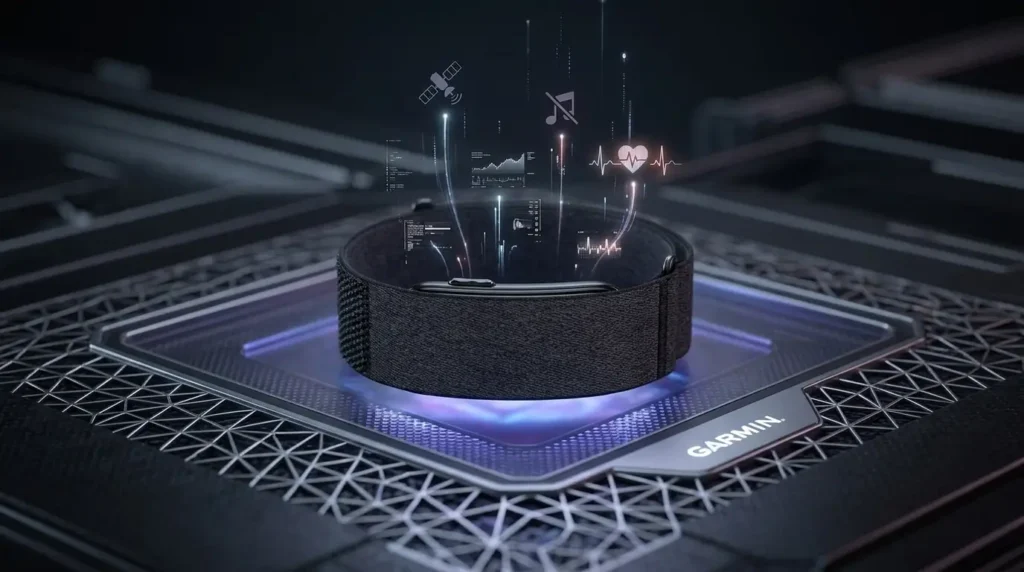
The Garmin CIRQA Smart Band launched at $199.99 with no required subscription, 10 days of battery, and a deliberate absence of a screen. That last part is the headline.
The rest of the omissions list is longer than the marketing suggests, and several items will disqualify the band outright for certain buyers.
Key Takeaways
- There is no onboard GNSS chip. Outdoor pace and distance depend entirely on a paired phone, which means running without your phone produces estimated numbers, not tracked ones.
- The CIRQA ships with Garmin’s Elevate Gen 4 optical sensor, so there is no ECG, no atrial fibrillation notification, and no EDA stress sensor.
- The band cannot charge on your wrist, cannot store music, cannot pay for anything, and cannot record an open water swim.
1. No Onboard GPS, Your Phone Does the Work
The CIRQA has no GNSS receiver. Positioning comes from Connected GPS, which pulls the location signal from a paired iPhone or Android handset over Bluetooth.
That is fine on a treadmill and fine on a commute where your phone is already in a pocket. It is a real constraint if your habit is leaving the phone at home for a morning run.
Without the phone, the band still logs the activity, heart rate, and duration. Distance and pace fall back to accelerometer estimation, which drifts on variable terrain and on pace changes.
Connected GPS also produces the map in your activity log. No phone means no route.
2. No ECG and No AFib Detection
Garmin fitted the CIRQA with the Elevate Gen 4 optical module, updated with skin temperature sensing. The Elevate Gen 5 found on the Index Sleep Monitor is not here, and neither is ECG hardware.
The practical consequences:
- No single-lead ECG recording, so no on-demand rhythm capture to show a physician
- No atrial fibrillation notifications, a feature Apple Watch and the Whoop MG both offer with FDA clearance
- No EDA sensor, despite pre-launch expectations. All-day stress is derived from heart rate variability instead
- No blood pressure feature of any kind
High and low heart rate alerts do exist, but Garmin’s manual restricts them to periods of at least ten minutes of inactivity, and disables them during your configured sleep window. This is a wellness device, not a cardiac screening device.
3. No Screen Means No Notifications
The band has one button and one multicolor LED. There is no display, and Garmin has confirmed there is no smart notification support at all.
You cannot see the time. You cannot see a text message. You cannot check heart rate, pace, or split data mid-workout without pulling out your phone and opening Garmin Connect.
Vibration handles a narrow set of alerts: goal completion, hourly movement, bedtime, sleep score, low battery, and alarms. Nothing from your phone gets through.
For a category built on reducing screen time, this is the point. For anyone expecting a Fitbit-style band with glanceable stats, it is a dealbreaker.
4. Swimming Limits at 50 Meters
The CIRQA carries a 5 ATM rating, equivalent to 50 meters of static water pressure. Showers, rain, and pool laps are all covered.
The limits are narrower than the rating implies. Garmin lists Pool Swimming as the only swim profile on the device, with no open water swimming option and no multisport profile for triathlon use.
The 5 ATM figure also does not authorize diving or high-velocity water sports. A useful side note: the fabric band is machine washable on a gentle cycle at up to 40C, but only with the module removed.
If open water is part of your training, this band cannot record it. Our comparison of the CIRQA against Whoop 5.0 covers how the two split on water and training profiles.
5. No Music Storage and No Contactless Payments
Garmin’s specification sheet lists 128 MB of memory and no music capability whatsoever. There is no onboard storage for tracks, no Spotify or Amazon Music offline sync, and no playback controls for audio running on your phone.
There is also no NFC radio, which rules out Garmin Pay. Connectivity is limited to Bluetooth Low Energy and ANT+, with no Wi-Fi for direct syncing.
The sensor package is similarly stripped. No barometric altimeter, no compass, no gyroscope, which means no floors climbed and less reliable elevation data on hikes.
6. No Charge-While-Wearing PowerPack
The CIRQA charges through a proprietary Garmin plug onto four-pin contacts. It is not USB-C, and it is not wireless. A full charge takes up to 90 minutes, and the band must come off your wrist for all of it.
Whoop solved this differently. Its Wireless PowerPack slides over the sensor while you wear it, so the device never leaves the body and the data stream never breaks.
At 10 days per charge, the CIRQA costs you roughly 90 minutes of missing data every week and a half. That matters more than it sounds for sleep streaks and recovery baselines. Anyone tracking connector standards will note this arrives during a period when wired connectivity naming is already a mess.
There is also a Battery Saver mode, and it is aggressive. Enabling it disables heart rate tracking, activity start, auto activity detection, and Pulse Ox, which switches off nearly everything the band was bought for.
7. Auto-Detection Misses Common Workouts
Manual tracking covers more than 80 activity profiles, but only through the app or the single button assigned to one favorite. Automatic detection is a much narrower net.
During setup, Garmin Connect asks you to nominate up to ten favorite activities. The classifier uses that list to narrow what it looks for, which means anything outside your ten is less likely to be caught.
Detection is also delayed. In hands-on testing, DC Rainmaker found auto-detected runs took 15 to 20 minutes after finishing to surface in the app, arriving as a phone prompt asking for confirmation of the activity type.
There is one more behavior worth knowing. If you manually record the same session on another Garmin device, the CIRQA activity is discarded in favor of the manual recording.
What Garmin Gets Right Anyway
The omissions are real, but the value proposition holds for a specific buyer. There is no mandatory subscription, which is the single biggest differentiator against Whoop.
| Feature | Garmin CIRQA | Whoop 5.0 | Fitbit Air |
|---|---|---|---|
| Price | $199.99 | Subscription only | $99.99 |
| Subscription required | No | Yes | No |
| Battery | 10 days | 14+ days | Varies |
| Onboard GPS | No | No | No |
| Charge on wrist | No | Yes (PowerPack) | No |
| Water rating | 5 ATM | 10 m | Water resistant |
Body Battery, Training Readiness, HRV Status, VO2 max, sleep staging, and skin temperature all arrive with the hardware purchase. Heart rate broadcasts over both ANT+ and Bluetooth, so gym equipment and Zwift work fine.
At roughly 21 grams with a woven nylon band, it disappears overnight in a way a Fenix does not. Wrist or upper arm placement is configurable in the app. The head-to-head against Fitbit Air breaks down what the extra $100 buys.
If you want to see what your own recovery and rhythm data look like, this referral link gets you a free month to test it properly. I get one too, which helps fund more hardware analysis at Rallynomics.
FAQ
Yes, but with reduced accuracy. The band records the activity, heart rate, and duration on its own, while distance and pace come from accelerometer estimates rather than satellite positioning. For accurate pace, splits, and a route map, the phone has to come with you.
Yes. The 5 ATM rating covers pool laps and showers, and Pool Swimming is an available activity profile. Open water swimming is not supported, and there is no multisport profile for triathlon.
Yes. The smart wake alarm vibrates within the 30 minutes before your set time and never delays past it, with a Quiet Start option that builds intensity gradually. A single button press snoozes the alarm and a long press stops it.
Running and walking are the reliable ones. Detection accuracy depends heavily on the up to ten favorite activities you nominate during setup, and results typically appear 15 to 20 minutes after the session ends as a confirmation prompt on your phone.
Great article, thanks for sharing!