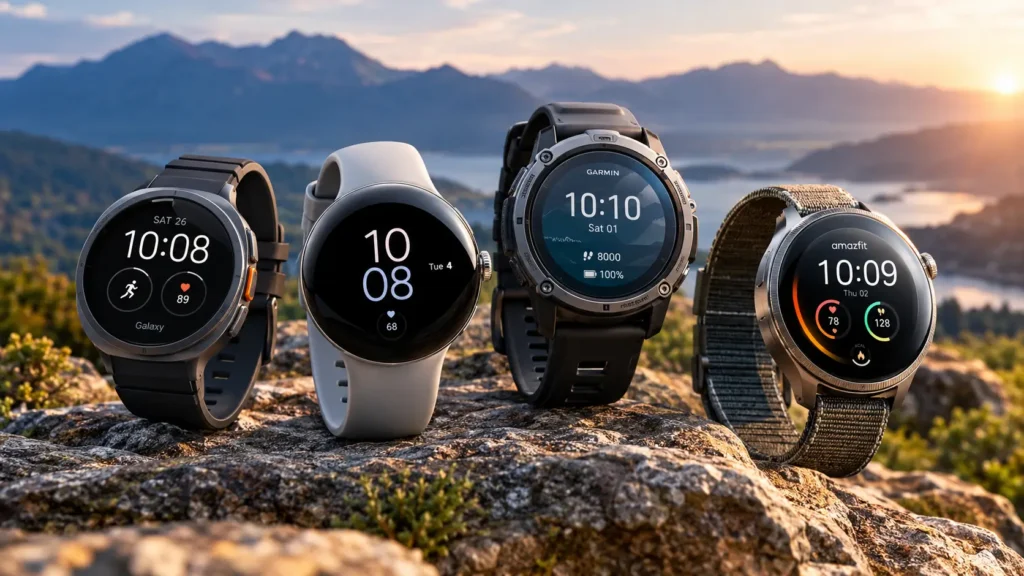
Most Wear OS watches still need a charger every night. The 2026 lineup finally splits into clear tiers: two-day Wear OS watches, multi-day hybrids, and fitness watches that run a full week or longer.
This guide ranks the best Android smartwatch for battery life by user profile, using hours with always-on display (AOD) on and off, current US pricing, and how often each model actually needs a charger.
Rallynomics may earn a commission when readers buy through retailer links on this page. Rankings are not affected.
Key Takeaways
- Pixel Watch 5 (45mm) is the best Wear OS pick: up to 40 hours with AOD on means one charge every two days for most users, with no app compromise.
- Amazfit Balance 2 is the multi-day value pick: up to 21 days rated at $299.99, in exchange for a smaller app ecosystem than Wear OS.
- Garmin covers week-long fitness use: the Vivoactive 6 lasts up to 11 days and the Venu 4 up to 12 days, both with full Android support through Garmin Connect.
How We Compared Real Battery Life
Manufacturer ratings rarely match daily use, so every watch here was judged on two inputs: official AOD-on and AOD-off ratings, and multi-week independent test results with heart rate, sleep tracking, and notifications enabled.
The deciding metric is charges per week with AOD on. That figure tells you whether a watch fits your routine or becomes another nightly chore.
Battery Life Side by Side
| Model | US price | AOD on | AOD off / saver | Charges per week (AOD on) |
|---|---|---|---|---|
| Pixel Watch 5 (45mm) | $429 | 40 h | 72 h (Battery Saver) | About 4 |
| Pixel Watch 5 (41mm) | $399 | 30 h | 48 h (Battery Saver) | About 6 |
| Galaxy Watch 9 (40/44mm) | From $379.99 | 30 h | 40 h | About 6 |
| Galaxy Watch Ultra 2 | $699.99 | 60 h | Not published | About 3 |
| Amazfit Balance 2 | $299.99 | 7 to 10 days (tested) | 21 days | 1 or fewer |
| Garmin Vivoactive 6 | $299.99 | 5 days | 11 days | 1 to 2 |
| Garmin Venu 4 (45mm) | $549.99 | 4 days | 12 days | About 2 |
Google does not publish a separate AOD-off rating for the Pixel Watch 5, so its extended figure is Battery Saver mode. Amazfit does not publish an AOD-on rating for the Balance 2, so that cell reflects real-world testing.
Best Overall: Long Battery and Full Wear OS
Pick: Google Pixel Watch 5 (45mm), $429
- AOD on: up to 40 hours
- Battery Saver: up to 72 hours
- Charging: about 50 percent in 15 minutes
The 45mm Pixel Watch 5 uses a 465 mAh cell. In extended testing with AOD on, it routinely reaches the 40-hour mark with 10 to 25 percent remaining, which makes it a dependable two-day watch.
Charging is the second advantage. The Quick Charge Dock restores half the battery in about 15 minutes, so a short top-up in the morning covers most of a day.
The 41mm model ($399) drops to 30 hours with AOD on, so size matters: buy the 45mm if endurance is the priority. LTE adds $100 to either size.
Where the Galaxy Watch 9 Fits
The Galaxy Watch 9 moves to the Snapdragon Wear Elite platform and gets larger batteries (390 mAh at 40mm, 445 mAh at 44mm). Samsung still rates both sizes at up to 30 hours with AOD on and 40 hours without, and real-world use lands closer to 24 to 30 hours.
It starts at $379.99 (40mm) and $409.99 (44mm), and a full recharge takes 1.5 to 2.5 hours. Choose it over the Pixel only if you own a Galaxy phone and want Samsung’s phone-linked health features.
Best Multi-Day Smartwatch for Android
Pick: Amazfit Balance 2, $299.99
- Rated battery: up to 21 days of typical use
- With AOD on: about 7 to 10 days in testing
- Battery capacity: 658 mAh
The Balance 2 runs Zepp OS instead of Wear OS, and that trade is what unlocks multi-week endurance. You still get an AMOLED display under sapphire glass, dual-band GPS, offline maps, Bluetooth calling, and health coaching with no subscription.
The cost is software depth. There is no Google Play Store and the third-party app catalog is limited. For users who want notifications, health data, and a weekly charge, that is a reasonable exchange, and US retailers regularly discount it to the $219 to $249 range.
What About Multi-Day Wear OS?
Only a few Wear OS watches break the two-day barrier, and both carry caveats:
- OnePlus Watch 3: rated for up to 120 hours, but OnePlus stopped launching products in North America in July 2026. Remaining units are leftover inventory with no successor coming to the US.
- TicWatch Pro 5 Enduro: rated for up to 90 hours in Smart Mode, but it runs an older Wear OS build than current Pixel and Galaxy models.
Best Fitness Watch With Week-Long Battery
Pick: Garmin Vivoactive 6, $299.99
- Smartwatch mode: up to 11 days
- AOD on: up to 5 days
- GPS: up to 21 hours
Garmin’s proprietary low-power software is why its AMOLED watches outlast Wear OS by five times or more. The Vivoactive 6 includes Body Battery, HRV Status, sleep coaching, and suggested workouts, and most owners get 8 to 10 days per charge with AOD off.
Step Up: Garmin Venu 4
The Venu 4 ($549.99) adds a stainless steel bezel, ECG, a built-in flashlight, and dual-band GPS. The 45mm model is rated for up to 12 days, or 4 days with AOD on, while the 41mm version is rated for 10 and 3 days.
Neither Garmin matches Wear OS for third-party apps, and payments run through Garmin Pay. If you want health data without a display at all, compare them with the best screenless fitness trackers in 2026.
Battery Settings That Matter Most
On any Android smartwatch, a handful of toggles account for most of the drain. Ranked by impact:
- Always-on display: the largest single drain. It cuts Wear OS runtime by roughly 25 to 45 percent and can reduce a Garmin to a third of its rated life.
- LTE: cellular models drain faster away from the phone. Keep LTE off unless you need standalone calls.
- Continuous SpO2 and heart rate: set blood oxygen to sleep-only and keep heart rate at the default interval.
- GPS workouts: an hour of GPS can consume 10 to 20 percent of a Wear OS battery.
- Tilt-to-wake and notifications: every wake lights the full panel, so mute high-volume apps such as group chats.
- Bedtime mode: disables wake gestures overnight without interrupting sleep tracking.
The phone side matters too, since the watch depends on a constant Bluetooth link. If your handset is the weak point, see the best battery smartphones of 2026.
When an Ultra Model Makes More Sense
Samsung Galaxy Watch Ultra 2, $699.99
- Battery: 800 mAh
- AOD on: up to 60 hours rated
- Charging: full in about 90 minutes
The Ultra 2 is the longest-running Wear OS watch from a major US brand. The 60-hour rating holds up in testing, and lighter users stretch it close to three days with AOD on.
It suits three profiles: outdoor users who need dive certification and MIL-STD-810H durability, LTE users who leave the phone at home, and anyone who rejects daily charging but will not leave Wear OS. Some health features, including ECG and blood pressure, still require a Galaxy phone.
For everyone else, the roughly $270 premium over the 45mm Pixel Watch 5 buys about 20 extra hours. Apple’s watches remain iPhone-only, and households split across platforms can see the current generation in Apple Watch Series 12 vs Series 11.
FAQ
Among the watches in this guide, the Amazfit Balance 2 leads with up to 21 days rated. The Garmin Venu 4 follows at up to 12 days. For full Wear OS, the Galaxy Watch Ultra 2 runs longest at up to 60 hours with AOD on.
Not on Wear OS. Samsung rates the Galaxy Watch 9 at 30 hours with AOD on versus 40 hours off, roughly a 25 percent drop. On low-power platforms the hit is larger: the Garmin Venu 4 falls from 12 days to 4.
Yes, in the larger size. The 45mm Pixel Watch 5 is rated for 40 hours with AOD on, versus 30 hours for both Galaxy Watch 9 sizes. At 41mm versus 40mm, both are rated for 30 hours, but the Pixel recharges much faster.
Almost any. Garmin Connect requires Android 7.0 or later with native Google Play Store support, so Android Go phones are excluded. Android users also get quick text replies from the watch, which iPhone owners do not.