Key Takeaways
- Efficiency now beats raw capacity: The flagships officially sold across the US and UK win endurance through silicon lithography and software power management, not just larger cells.
- The new baseline has climbed: Mid-range devices in both markets now ship with 5,000 mAh or more, paired with 60W-plus wired charging that restores a full day in minutes.
- Availability defines the shortlist: Many record-setting large-battery phones ship only in Asia. The devices below are the endurance leaders you can actually buy through official US and UK channels.
The 2026 Battery Endurance Leaders (US and UK Availability)
| Model | Capacity | Charging | Estimated Endurance | Key Advantage |
|---|---|---|---|---|
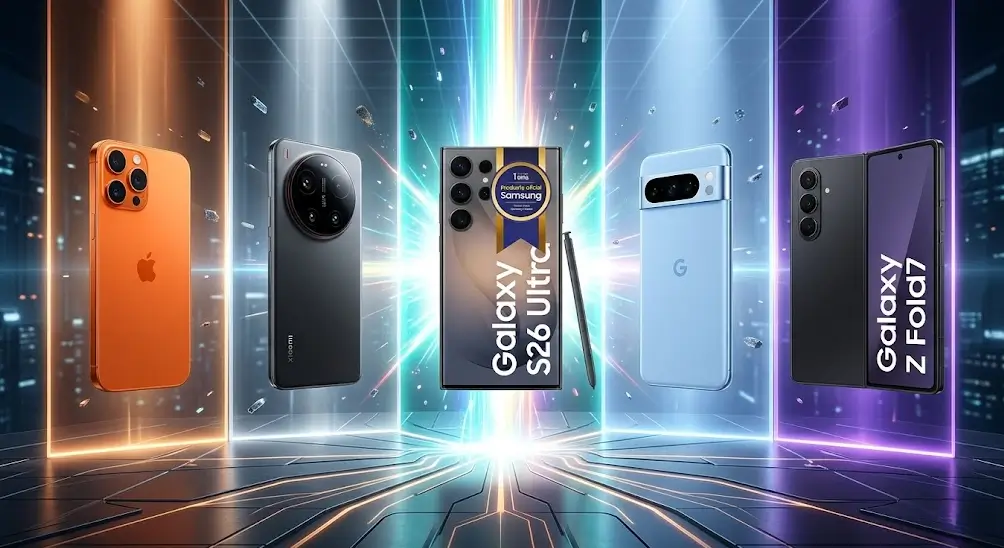
| Samsung Galaxy S26 Ultra | 5,000-6,000 mAh | 60W wired / 25W Qi2 | Up to 15h intensive active screen | S-Pen plus advanced software power management |
| iPhone 17 Pro Max | 5,088 mAh | 35-40W | 39h declared video playback | A19 Pro low-power architecture |
| Google Pixel 10 Pro XL | 5,200 mAh | 45W wired / 25W wireless | Full day plus, adaptive management | Tensor efficiency with on-device AI scheduling |
| Motorola Edge (2026) | 5,000 mAh | 60W wired / 15W wireless | Up to 50h mixed use | Full-day charge in roughly 7 minutes |
| Nothing Phone (3a) Pro | 5,080 mAh | 50W wired | Up to 2 days light use | Efficient mid-range tuning at a competitive price |
Every device in this table is available through official channels in both the United States and the United Kingdom, whether unlocked, via carriers, or direct from the manufacturer.
The Silicon-Carbon Revolution
Graphite dominated battery anodes for decades for a single, straightforward reason: stability. Silicon stores up to ten times more lithium ions per gram, but expands between 300% and 400% during charging, generating microfractures that destroy the cell within a limited cycle count.
The solution deployed at scale in 2026: encapsulating silicon nanoparticles inside carbon matrices. The carbon absorbs the expansion and preserves conductivity. This result is an energy density that jumps from the conventional 550-700 Wh/L range to more than 900 Wh/L.
There is an important caveat for Western buyers. Many of the record-setting large-capacity devices built on this chemistry, including cells rated at 7,000 mAh and above, launch exclusively in India and Southeast Asia.
Safety regulations governing the transport of high-energy-density materials have not been updated in several jurisdictions to accommodate silicon-carbon chemistry, which restricts official distribution outside Asia. The practical consequence is that the highest raw numbers on paper are frequently unavailable through official US and UK channels.
This shift in battery chemistry is not an isolated development. It is part of the same architectural pressure reshaping the entire mobile hardware stack, including next-generation processors and their direct impact on power draw.
Two Strategies, One Goal
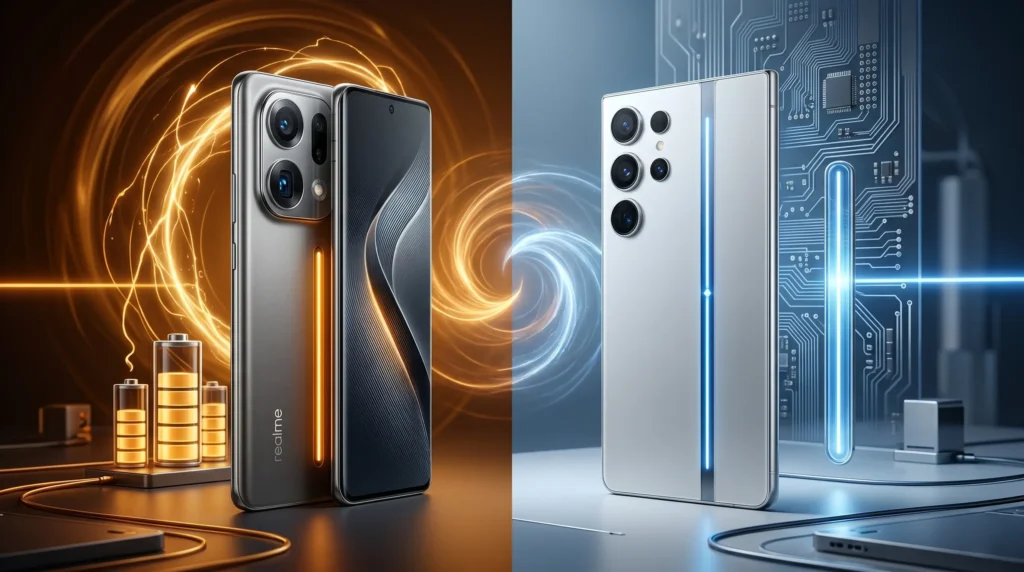
The mobile market in 2026 operates under two opposing philosophies for solving the endurance problem.
Strategy 1: Raw Physical Capacity
A group of primarily Asia-focused manufacturers has committed fully to silicon-carbon chemistry, deploying cells from 7,000 mAh upward to absorb the power demands of high-speed 5G networks and high-refresh-rate displays. The energy reserve acts as a structural buffer against peak consumption spikes.
The limitation for readers in the US and UK is distribution: these devices rarely reach official retail or carrier channels in either market, leaving import as the only route and forfeiting warranty and software-update guarantees.
Strategy 2: Silicon-Level Efficiency
Apple, Samsung, and Google prioritize processor lithography and software-layer optimization. The iPhone 17 Pro Max, at 5,088 mAh, competes directly on endurance with devices carrying significantly higher capacities, driven by the A19 Pro architecture and iOS power management routines.
The Samsung Galaxy S26 Ultra extracts maximum output through the Snapdragon 8 Elite Gen 5, while the Google Pixel 10 Pro XL leans on Tensor efficiency and on-device AI scheduling. This is the strategy that dominates the shelves in both Western markets.
For a direct hardware comparison between these two philosophies applied to real-world benchmarks, the Xiaomi 17T Pro vs. iPhone 17 Pro Max analysis maps precisely how raw battery size and silicon efficiency translate into measured results.
The Value Tier: Motorola and Nothing
Endurance is no longer confined to the flagship price bracket. The Motorola Edge (2026), sold at 599 USD through Motorola.com and Best Buy in the US and through Motorola directly in the UK, pairs a 5,000 mAh cell with 60W wired charging that Motorola rates at a full day of use from roughly seven minutes on the charger.
Nothing occupies a similar position, delivering multi-day light-use endurance and 50W charging at a competitive price in both markets. For most users, these mid-range devices have made the daily charger optional hardware.
The Processor’s Role in Real-World Endurance
Nominal battery capacity is only one variable in the equation. New-generation processors integrate NPUs (Neural Processing Units) that manage power consumption of individual components in real time, including the display, the 5G modem, and background application workloads.
A device with a 5,000 mAh cell and an efficient processor can outperform one rated far higher paired with a less refined chip under actual usage conditions. This is precisely why the efficiency-first flagships hold their own against the raw-capacity devices they never share a shelf with.
Understanding how processor architecture directly governs power draw is essential to evaluating these devices accurately, a dimension covered in technical depth in the Best High-End Smartphones of 2026 breakdown.
FAQ
They replace the graphite anode with a nanostructured silicon-carbon alloy. Silicon stores up to ten times more lithium ions per gram, but historically expanded during charging and destroyed the cell structure within a limited cycle count. Encapsulating it inside a carbon matrix stabilizes the expansion: higher capacity in the same physical volume, with comparable lifespan to conventional cells.
The strongest endurance devices officially available in both markets are the Samsung Galaxy S26 Ultra, the iPhone 17 Pro Max, the Google Pixel 10 Pro XL, and, in the value tier, the Motorola Edge (2026) and Nothing Phone (3a) Pro. Many higher-capacity phones with cells above 7,000 mAh launch only in Asia and are not sold through official US or UK channels.
No. Real-world endurance depends on the combination of cell capacity, processor efficiency, and software power management. An efficient chipset paired with a 5,000 mAh cell can outlast a larger battery attached to a less refined processor, which is why the efficiency-focused flagships remain competitive.
Significantly. Current 2026 operating systems integrate AI-driven power and thermal management layers that monitor consumption in real time and actively prevent accelerated cell degradation. Android in its current release includes dedicated diagnostic alerts that identify background applications generating abnormal energy drain patterns.