
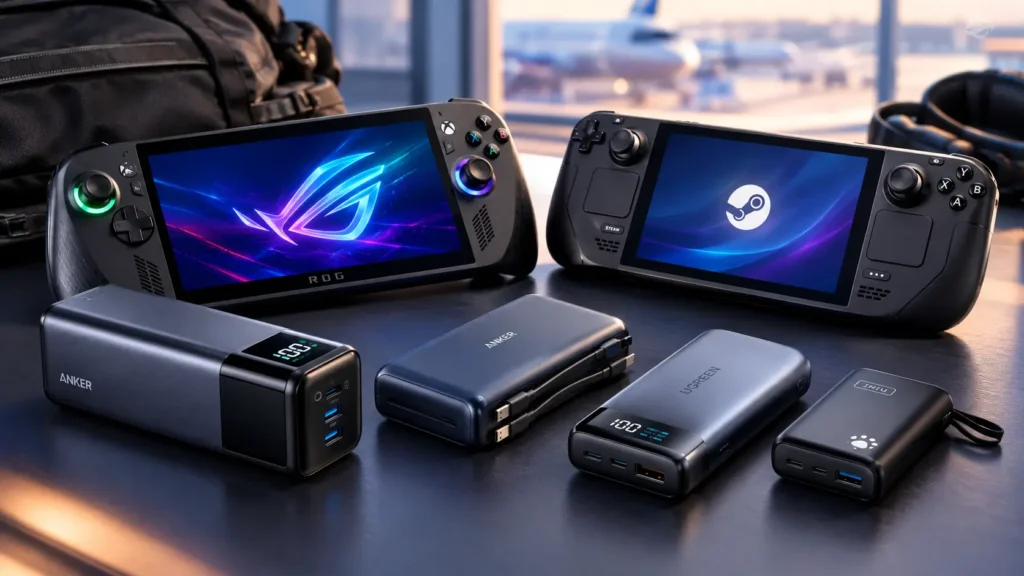
The ROG Xbox Ally X carries an 80Wh battery and the Steam Deck OLED a 50Wh one. In demanding games, both can run dry in roughly two hours.
Choosing the right power bank for the ROG Ally X or Steam Deck starts with one number: sustained output in watts. Capacity in mAh only matters once the wattage is right.
Key Takeaways
- 65W is the real floor for the ROG Xbox Ally X. A weaker bank slows the drain in heavy games but cannot add charge in Turbo mode.
- The Steam Deck OLED never asks for more than 45W. A $50-class 100W bank already delivers its full charging rate, with headroom to spare.
- Stay at or under 100Wh to fly. A 25,000mAh bank (about 90Wh) clears every major US airline without special approval.
How Many Watts Each Handheld Needs
Battery capacity tells you how much energy a handheld stores. System draw tells you how fast it burns through it, and whether a power bank can match it under load.
| Handheld | Battery | Included charger | Heavy-load draw | Bank for play-and-charge |
|---|---|---|---|---|
| ROG Xbox Ally X | 80Wh | 65W | ~28W to ~40W | 65W or more |
| Steam Deck OLED | 50Wh | 45W | ~23W | 45W or more |
The base ROG Xbox Ally (60Wh) ships with the same 65W charger and runs a lower-power chip, so every bank in this guide covers it. The discontinued Steam Deck LCD (40Wh) uses the same 45W input as the OLED.
Where the draw figures come from
These are whole-system averages derived from published battery-life tests: capacity divided by runtime. The Ally X ran about 2 hours 52 minutes in Performance mode (17W TDP) and about 2 hours in Turbo. The Deck OLED lasted about 2 hours 11 minutes in Control.
They are not inline USB-C meter readings. Rallynomics has not yet metered either device in a demanding game, so treat them as planning estimates within a few watts.
If you are still choosing hardware, our handheld buying guide with every current US price compares battery and power budgets across the category.
Best Power Bank That Charges While Playing
Anker Prime Power Bank (26,250mAh, 300W)
This is the bank that keeps the ROG Xbox Ally X gaining charge in Turbo mode. Each USB-C port delivers up to 140W, so the handheld takes its full intake while a second port tops up a phone or earbuds.
Anker Prime Power Bank – 26,250mAh – 300W – Fast Charging
Precio: $229.99
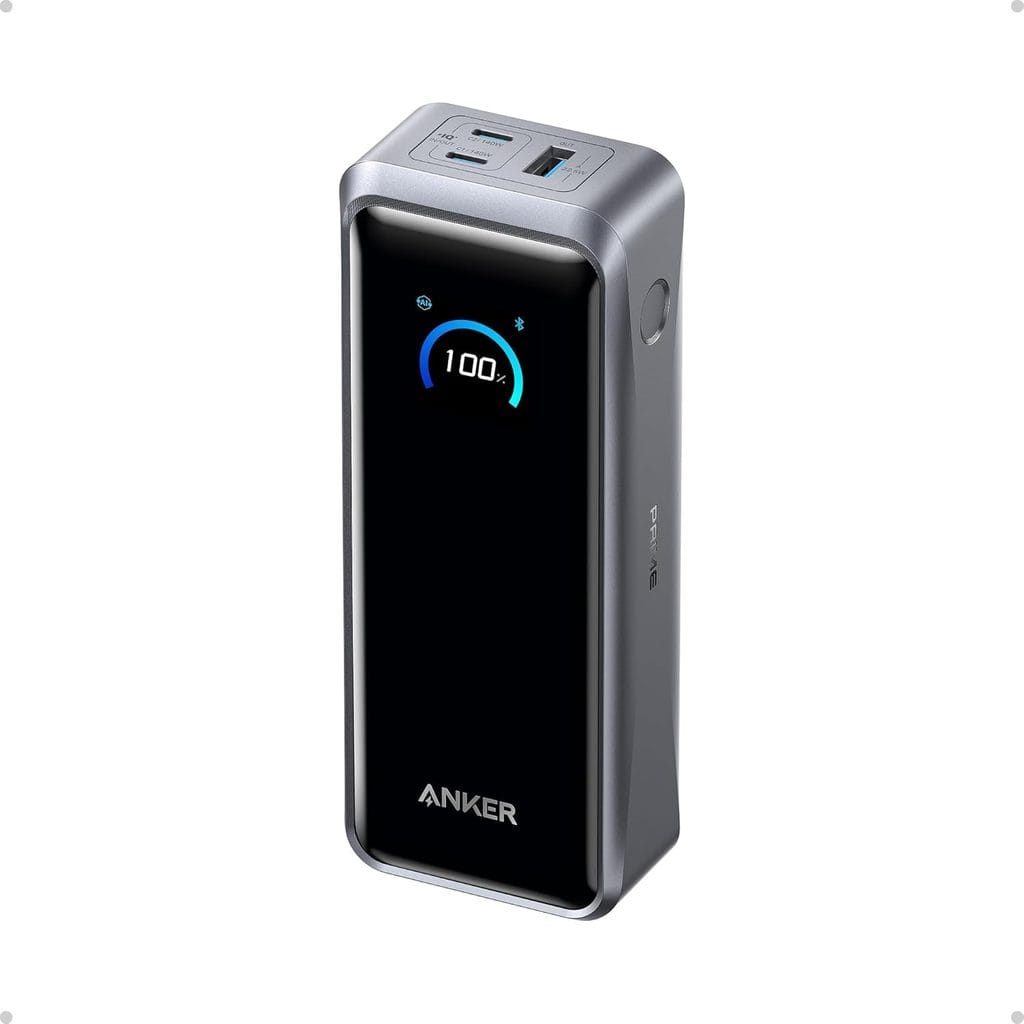
- Capacity: 26,250mAh (99.75Wh)
- Output: 140W per USB-C port, 300W total
- Ports: 2x USB-C, 1x USB-A, built-in display
- Price: $229.99 list, often $170 to $180 on Amazon
At 99.75Wh it sits just under the 100Wh airline ceiling. The trade-off is price: it costs roughly four times the budget pick below.
Value alternative: Anker Laptop Power Bank (25K, 165W)
Anker Laptop Power Bank – 25,000mAh – 165W Total Output
Precio: -22% $104.99
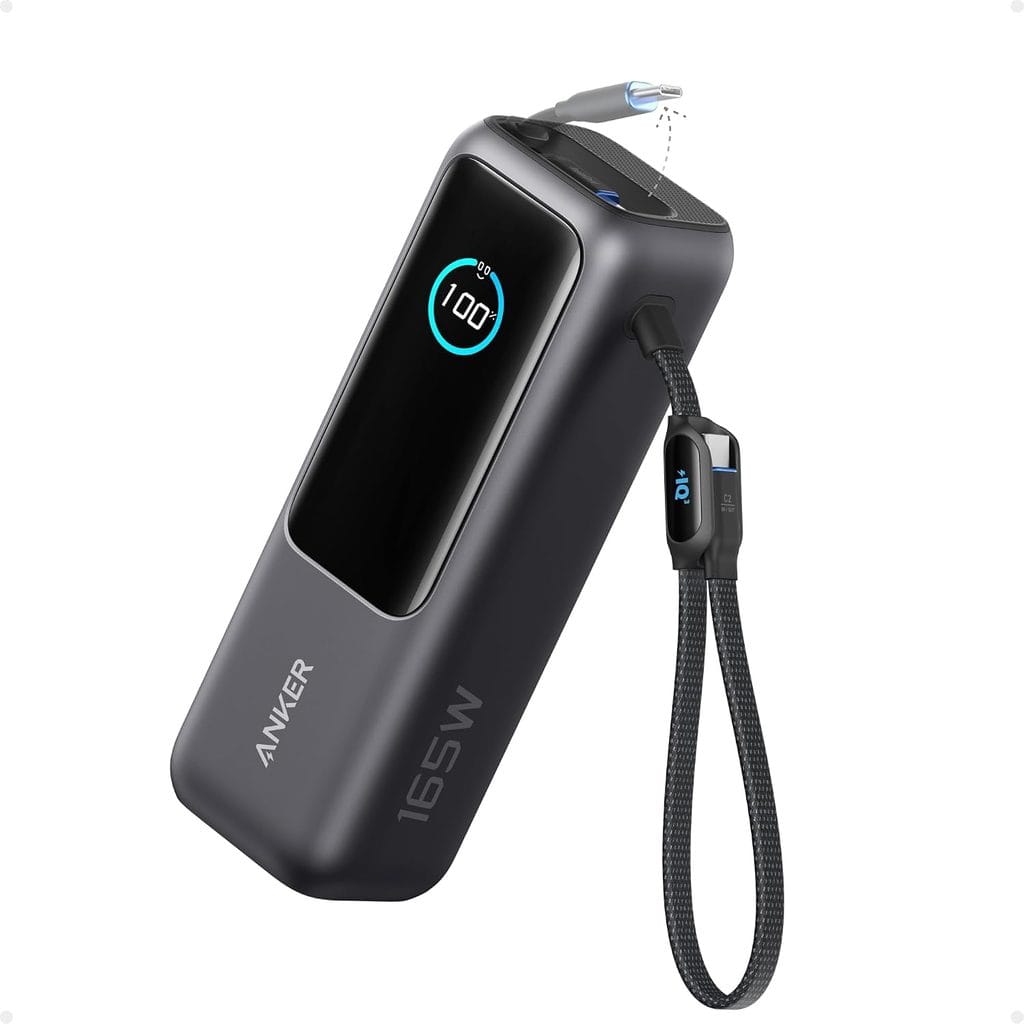
At $119.99, this model drops the display but adds two built-in USB-C cables rated for 100W each. You get the same play-and-charge headroom for the Ally X without carrying a separate cable.
One cable detail matters here. A standard 3A USB-C cable caps power at 60W, which covers the Ally X’s roughly 60W intake. A 5A cable only becomes necessary when the same bank feeds a laptop, a distinction explained in our USB4 and Thunderbolt 5 breakdown.
Best Compact Power Bank for Travel
UGREEN Nexode Power Bank (20,000mAh, 130W)
The UGREEN Nexode balances size and output better than anything else in its class. Its 100W USB-C port exceeds what either handheld can draw, and its 74Wh capacity refills a Steam Deck OLED about once.
UGREEN Nexode – 20,000mAh – 130W
Precio: -33%$59.99
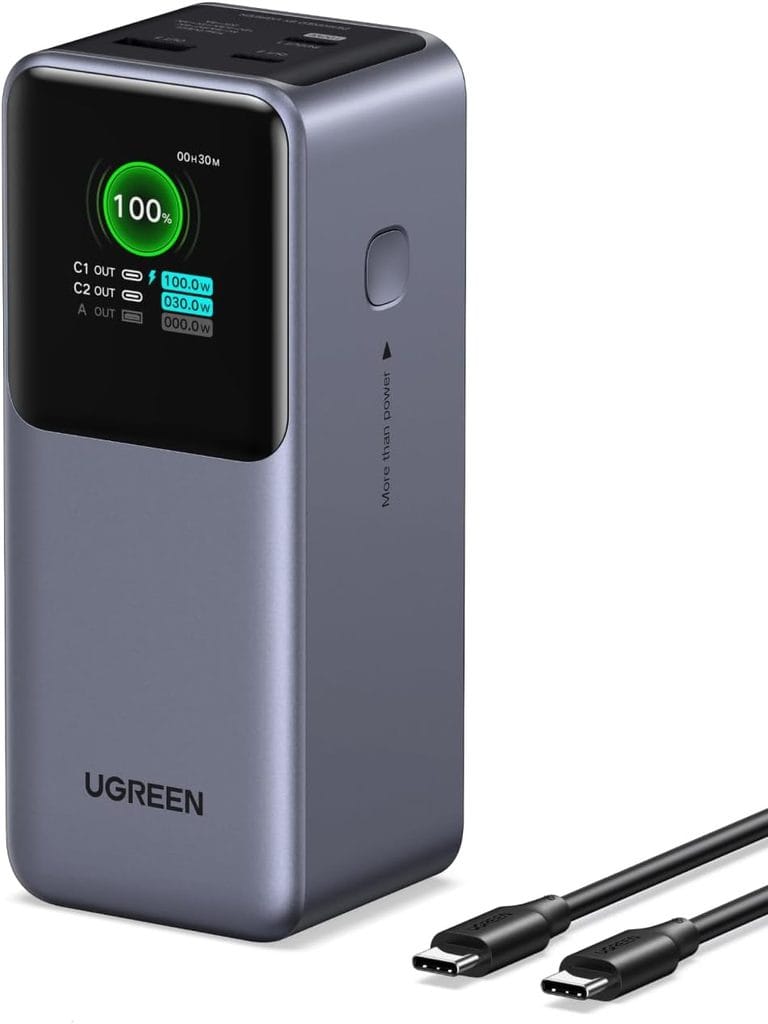
- Capacity: 20,000mAh (74Wh)
- Output: 100W from the primary USB-C port
- Ports: 2x USB-C, 1x USB-A
- Price: $79.99 list, commonly around $50 on Amazon
For the Ally X, it recovers roughly two-thirds of the internal battery. That is enough to cover a long layover in Performance mode.
Smallest option: Anker Nano Power Bank (10K, 30W)
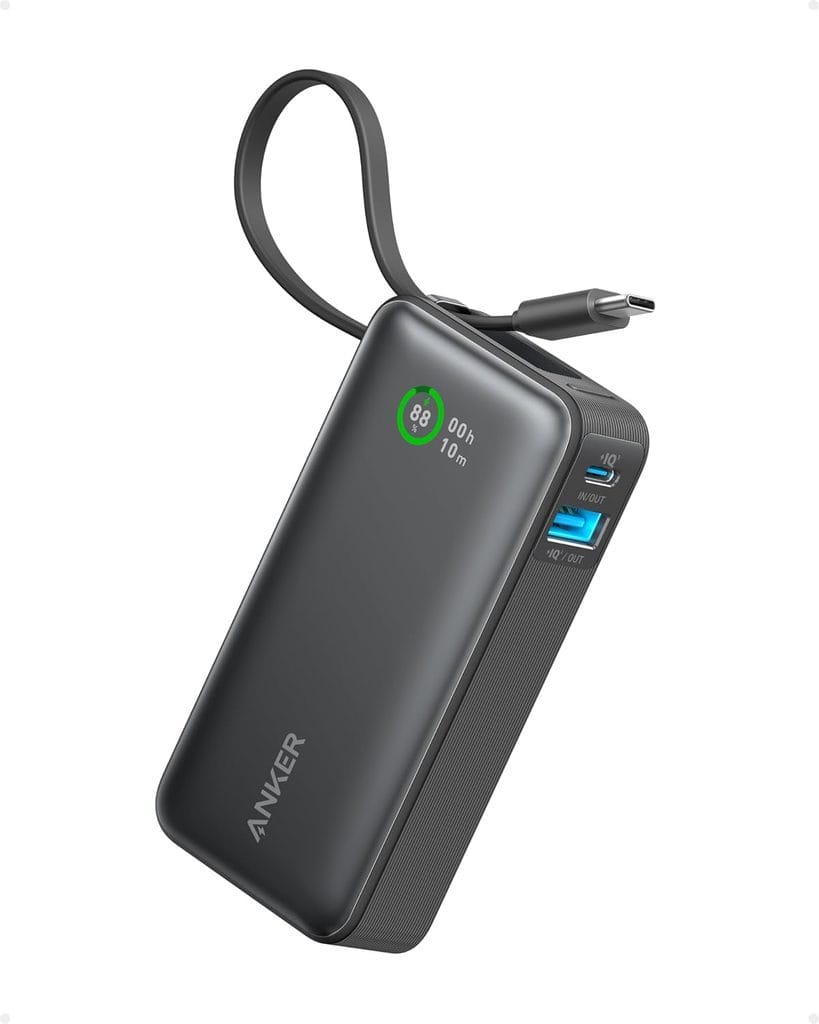
The Anker Nano, around $30 with a built-in USB-C cable, fits a jacket pocket. It cannot sustain the Ally X under heavy load, but it extends a Steam Deck session by about an hour.
Anker Nano Power Bank – 10,000mAh – 30W
Precio: $49.99
If your trip ends at a desk or hotel TV, pair your bank with one of the USB-C hubs and docking stations in our 2026 guide to run the handheld as a compact desktop.
Best Budget Power Bank for Steam Deck
INIU Power Bank (25,000mAh, 100W)
The INIU 25,000mAh is the efficient buy for Steam Deck owners. The Deck tops out at 45W, and this bank’s secondary USB-C port alone delivers exactly that.
INIU Laptop Power Bank – 25,000mAh – 100W – Fast Charging
Precio: $66.99

- Capacity: 25,000mAh (about 90Wh)
- Output: 100W and 45W USB-C, 18W USB-A
- Weight: about 16.7 oz
- Price: $59.98 list, frequently under $50
Its 100W primary port also handles the ROG Xbox Ally X at full intake. That makes it the lowest-cost bank in this guide that serves both handhelds without compromise.
The trade-off is build and polish: no premium display and a thicker body (about 1.34 inches). For a backpack, neither matters much.
Capacity vs Real Extra Playtime
A power bank’s mAh rating refers to its internal cells at about 3.6V. Stepping that up to 20V USB-PD and charging the handheld’s battery costs roughly 15 to 25% of the energy.
This guide uses a conservative 75% delivery rate. The formula: extra hours = (rated Wh × 0.75) ÷ system draw.
| Power bank | Rated | Usable | Deck OLED (23W) | Ally X Perf. (28W) | Ally X Turbo (40W) |
|---|---|---|---|---|---|
| Anker Nano 10K | ~36Wh | ~27Wh | 1.2 h | 1.0 h | 0.7 h |
| UGREEN Nexode 20K | 74Wh | ~55Wh | 2.4 h | 2.0 h | 1.4 h |
| INIU 25K 100W | ~90Wh | ~67Wh | 2.9 h | 2.4 h | 1.7 h |
| Anker Laptop 25K | ~90Wh | ~67Wh | 2.9 h | 2.4 h | 1.7 h |
| Anker Prime 26K | 99.75Wh | ~75Wh | 3.3 h | 2.7 h | 1.9 h |
These are calculated values, not lab measurements. Lower brightness, a 40 FPS cap, or Silent mode on the Ally X (about 19W of system draw) stretch every figure.
To verify your own setup, an inline USB-C power meter between the bank and the handheld shows the real wattage in any game.
Airline Rules for Large Power Banks
Power bank rules tightened across US carriers in 2026. The FAA baseline still applies everywhere:
- Up to 100Wh: allowed in the cabin, no approval needed
- 101Wh to 160Wh: airline approval required, two maximum
- Over 160Wh: prohibited
- Checked bags: never allowed
New international guidance adopted in March 2026 limits passengers to two power banks and bars recharging them in flight. US airlines then layered their own rules on top.
| Airline | Banks allowed | Overhead bin | Key restriction |
|---|---|---|---|
| Southwest | 1 | Not allowed | Keep visible while in use |
| American | 2 (100Wh max) | Not allowed | No recharging the bank onboard |
| United | 2 | Not allowed | Store in under-seat item |
| Delta | 2 (100Wh max) | Not specified | Standard FAA limits |
| Alaska | Per FAA | Allowed | Standard FAA limits |
Every bank in this guide is at or under 100Wh, so none needs approval. Policies changed several times this year, so check your carrier’s page before you fly.
To find a bank’s rating, look for Wh on the label. If only mAh is printed, multiply by 3.6 and divide by 1,000.
FAQ
Only under light loads. In Silent mode the system draws about 19W, so a 30W bank adds roughly 10W of net charge. In Performance mode it roughly breaks even, and in Turbo the internal battery still drains, just more slowly.
A 20,000mAh bank (about 74Wh) refills a Steam Deck OLED roughly once after conversion losses. A 25,000mAh bank delivers about 1.3 refills, which covers most cross-country flights.
Yes. At 3.6V, 25,000mAh equals 90Wh, below the 100Wh limit for carry-on without approval. Keep it out of checked bags and overhead bins, and note that Southwest allows only one bank per passenger.
No. Both handhelds negotiate their own charging rate over USB-PD, so a 140W bank never forces more power than the device requests. Heat and long stretches at 100% cause more wear, which is why Armoury Crate SE and SteamOS both offer a charge-limit setting.


Appreciate the dedication to detailed analysis here. Keep up the great work!