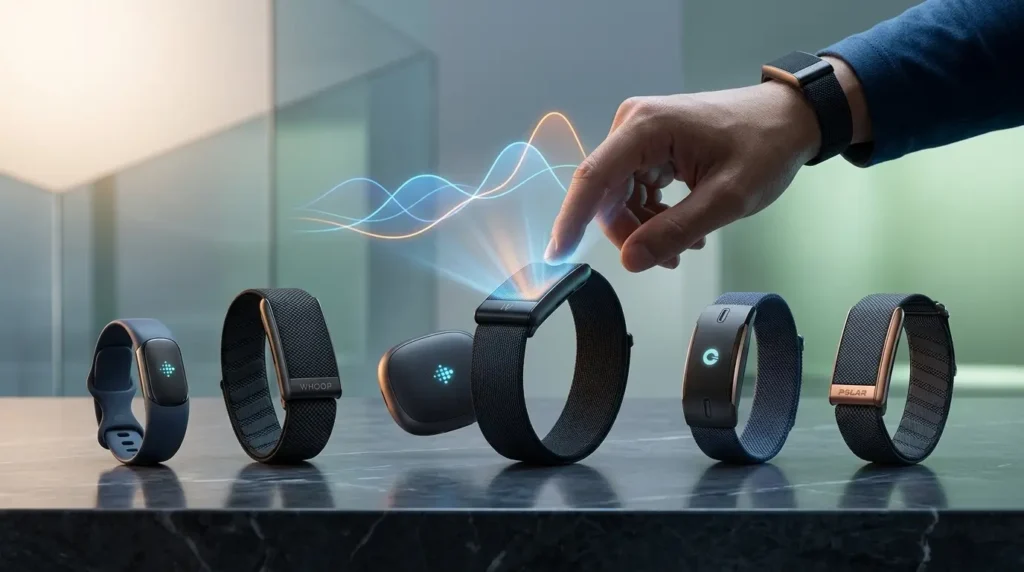
The screenless tracker category stopped being a niche in 2026. Google shipped the $99.99 Fitbit Air in May, Garmin answered with the $199.99 CIRQA Smart Band in July, and Amazfit and Polar already had bands in the market. Whoop still sells the same idea as a recurring bill.
Key Takeaways
- Fitbit Air is the cheapest entry at $99.99 and the only screenless band here with FDA-cleared background AFib detection, which makes it the best value for passive health screening.
- Garmin CIRQA costs $199.99 once and pipes Body Battery, HRV Status and Training Readiness into the free Garmin Connect app, so serious training data carries no recurring fee.
- Whoop is the only option that stops working when you stop paying, and at $199 to $359 per year it costs three to ten times more than the alternatives across a three-year window.
Why screenless trackers exist
A screenless band is not a cheaper smartwatch. It is a sensor package optimized for uninterrupted wear, which is exactly what continuous heart rate, HRV and sleep staging require.
Removing the display buys three things: weight, battery, and attention. The Fitbit Air weighs 12 grams with its band and the Amazfit Helio Strap lands near 20 grams. A Whoop 5.0 sits at roughly 26.5 grams, and a smartwatch weighs two to three times more than any of them.
The trade is real. No display means no live pace, no split times, and no glanceable heart rate zone during a workout. Everything moves to the phone app.
That trade only makes sense for a specific user: someone tracking recovery and long-term trends rather than in-session performance.
Screenless tracker comparison: hardware and sensors
| Device | Price | Battery | AFib alerts | SpO2 | Wear position |
|---|---|---|---|---|---|
| Fitbit Air | $99.99 | Up to 7 days | Yes, FDA-cleared | Yes | Wrist |
| Amazfit Helio Strap | $99.99 | Up to 10 days | No | Yes | Wrist or upper arm |
| Garmin CIRQA | $199.99 | Up to 10 days | No | Yes | Wrist or upper arm |
| Polar Loop | $199.90 | Up to 8 days | No | No | Wrist |
| Whoop 5.0 | Subscription only | Rated 14+ days | No | Yes | Wrist or bicep |
None of these bands has onboard GPS. All five borrow your phone’s GPS for pace and route data, so outdoor workouts still require carrying a handset.
Screenless tracker comparison: three-year cost
Most comparisons stop at sticker price. That hides the only number that matters over a normal ownership cycle.
| Plan | Hardware | Required fee | 3-year total |
|---|---|---|---|
| Fitbit Air | $99.99 | None | $99.99 |
| Amazfit Helio Strap | $99.99 | None | $99.99 |
| Garmin CIRQA | $199.99 | None | $199.99 |
| Polar Loop | $199.90 | None | $199.90 |
| Whoop One | Included | $199/yr | $597 |
| Whoop Peak | Included | $239/yr | $717 |
| Whoop Life (MG) | Included | $359/yr | $1,077 |
Optional subscriptions exist on two of the four no-fee devices. Garmin Connect+ runs $6.99 monthly or $69.99 annually, and Google Health Premium runs $9.99 monthly or $99 annually. Neither is required for core tracking.
Amazfit and Polar have no paid tier at all. Every feature ships unlocked with the hardware, which is the cleanest cost structure in the category. Our full Garmin CIRQA versus Whoop cost breakdown runs the same math against every Whoop tier.
Garmin CIRQA at $199 with no subscription
CIRQA launched July 21, 2026 and reached shelves July 24. It is a fabric loop strap, a single side button, a vibration motor, and no display of any kind.
The sensor package is Garmin’s Elevate Gen 4 module, not the newer generation shipping in current watches. In practice that difference is minor for sleep and daily heart rate, and irrelevant for resting metrics.
What the free tier actually includes
- Body Battery, HRV Status and Health Status
- Training Readiness, Training Status and VO2 Max
- Sleep score, stress, SpO2 and skin temperature
- Automatic detection across a wide activity list
- 5 ATM water rating and ANT+ heart rate broadcast
The weak point is auto-detection maturity. In extended side-by-side testing, DC Rainmaker found Garmin’s automatic activity classification lagging behind what Fitbit and Whoop already do reliably, which matters more on a band with no screen to correct it mid-session.
TrueUp sync is the strongest argument here. If you already own a Garmin watch, CIRQA fills the overnight and off-day gaps without fragmenting your training history. Our head-to-head between the CIRQA and the Fitbit Air breaks down where each one wins.
Fitbit Air at $99 with AFib detection
The Fitbit Air is a 5.2 gram pebble that drops into swappable bands. It is Google’s first new Fitbit hardware in years and the first built around the Google Health app rather than the legacy Fitbit app.
At $99.99 it is the only screenless band on this list with FDA-cleared background AFib detection. There is no manual ECG, so this is passive screening rather than an on-demand reading.
Battery runs a rated seven days, with a five-minute fast charge covering a full day. That fast-charge behavior matters on a device meant to stay on your wrist through sleep.
No other band here matches it on cardiac screening. Our breakdown of whether the Garmin CIRQA detects AFib explains exactly what Garmin’s band does and does not flag.
Every unit ships with a three-month Google Health Premium trial. The Stephen Curry Special Edition runs $129.99, and accessory bands start at $34.99.
Amazfit Helio Strap at $99 with upper-arm wear
The Helio Strap is the cheapest way into per-second heart rate tracking with a real training framework behind it. It weighs about 20 grams, runs a rated 10 days per charge, and carries a 5 ATM rating.
Everything runs through the free Zepp app. There is no premium tier, no gated metric, and no upsell after purchase.
Where it separates from the field
- 27 sports modes plus automatic strength exercise recognition
- Dedicated HYROX Race mode for hybrid competition prep
- VO2 Max, training load and recovery time at no extra cost
- Heart rate broadcast to watches, bike computers and gym equipment
- Optional armband accessory for upper-arm placement
Reviewers consistently flag the same two limits: minor heart rate accuracy wobbles under load and readiness insights that lack Whoop’s depth. The plastic housing also feels its price.
Stock has been inconsistent through 2026, and Zepp Health has confirmed a second-generation Helio Strap for the back half of the year. Buying the current unit at full price this late in the cycle carries obvious timing risk.
Polar Loop at $199 with subscription-free sleep science
The Polar Loop is the purist option: a 29 gram textile band with a stainless-steel buckle, no screen, no buttons, and no notifications at all. It shipped September 10 at $199.90.
Inside is Polar’s Precision Prime optical sensor feeding the free Polar Flow app. Sleep stages, Nightly Recharge recovery scoring and SleepWise alertness forecasting are all included permanently.
Battery runs a rated eight days, water resistance is WR30, and the band stores four weeks of data locally before it needs to sync.
The omissions are specific and worth knowing. There is no SpO2 sensor, no AFib detection, no onboard GPS, and no heart rate broadcast: the single Bluetooth connection is reserved for Polar Flow.
That last point rules it out for anyone who wants to feed live heart rate to a bike computer or a gym display. For overnight recovery tracking, Polar’s sleep methodology remains among the most mature in consumer wearables.
Whoop 5.0 and the subscription trade
Whoop restructured to three tiers in 2025 and has held US pricing since: One at $199 per year, Peak at $239, and Life at $359 with the medical-grade MG hardware.
The hardware is free. The data is not. There is no way to buy a Whoop outright, and the band stops syncing the moment a membership lapses.
What you get for the fee is the most mature recovery framework in the category. Recovery score, Strain targets and sleep coaching are tightly integrated, and the wireless PowerPack lets you charge without removing the band.
Whoop also supports bicep wear, and placement studies using identical Whoop units found upper-arm positioning measurably more accurate than the wrist.
The rated 14-day battery is optimistic. Real-world testing on high-strain days lands closer to five to seven days. Our long-term Whoop 5.0 log covers what 320 days of continuous wear actually produced.
Pick by what you actually train for
Structured endurance training
Buy the Garmin CIRQA. Training Readiness, Training Status and VO2 Max at no recurring cost is the strongest free training stack available, and TrueUp keeps it consistent with a Garmin watch.
Passive health monitoring
Buy the Fitbit Air. AFib screening, a seven-day battery and a $99.99 entry price make it the cheapest credible way to watch cardiac and sleep trends long term.
Strength work and hybrid racing
Buy the Amazfit Helio Strap. Automatic rep and set recognition, HYROX Race mode and upper-arm placement address exactly what wrist-worn optical sensors handle worst.
Sleep and recovery first
Buy the Polar Loop. Nightly Recharge and SleepWise deliver the most developed sleep science in the category with zero recurring cost, provided you can live without SpO2.
Recovery-driven programming
Buy Whoop, and budget for it. If you actually adjust training intensity based on a daily Recovery score, the framework justifies the fee. If you check the app twice a week, it does not.
FAQ
Fitbit Air and Amazfit Helio Strap tie at $99.99 total, assuming you skip Google Health Premium. Garmin CIRQA and Polar Loop sit near $200. Whoop One, the cheapest Whoop tier, reaches $597 over the same period because the membership is mandatory.
Only the Fitbit Air, using FDA-cleared background heart rhythm monitoring with AFib alerts. Garmin CIRQA, Polar Loop, Amazfit Helio Strap and Whoop 5.0 offer no AFib detection and no ECG. Whoop’s medical-grade MG hardware, available on the $359 Life tier, adds on-demand ECG.
Not meaningfully. All five require their companion app for setup, viewing data and firmware updates, and none has onboard GPS. Polar Loop buffers four weeks of data locally and Fitbit Air holds roughly seven days of motion data, so short sync gaps are harmless. You still need a phone to read anything.
Whoop has the strongest published validation record, with peer-reviewed comparisons against polysomnography showing the smallest gap on total sleep time, though it overestimated REM. Fitbit hardware performed better on REM detection in the same review. In practical side-by-side testing, Fitbit Air and Whoop now land within about 15 minutes of each other on total sleep after a two-day calibration period.