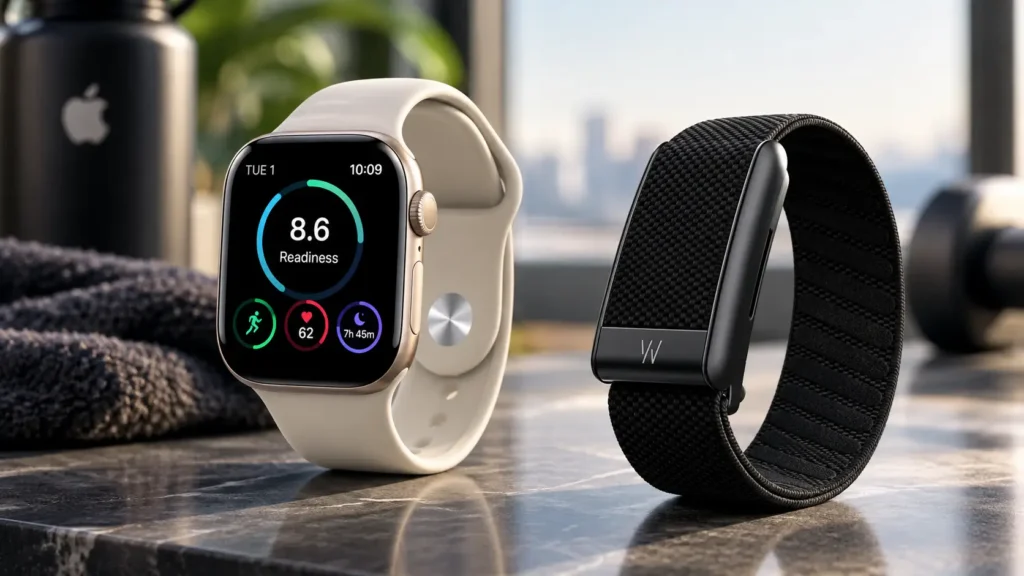
Whoop built a business around one number: the recovery score you check on waking to decide whether to train hard or rest. On September 9, Apple shipped its own version inside the Apple Watch Series 12. Readiness runs from 0 to 10, and it is included in a watch that costs $399 once.
Whoop does not sell hardware. It sells an annual membership with the device bundled in. That turns this comparison into an amortization question, and in the US the answer arrives faster than most buyers expect.
Battery is where the two separate. Series 12 is rated at 24 hours. Whoop 5.0 is rated at 14+ days. Measuring recovery with Apple means adding a charging window to your daily routine.
Key Takeaways
- Readiness no longer requires a membership. The 0 to 10 score and its four recommendations (Recover, Pace Yourself, Ready, Go For It) come bundled with Series 12 at $399, with no recurring fee attached.
- The watch pays for itself in under two years. Against Whoop Peak the break-even lands near 20 months, and against Whoop One near 24 months, roughly the window in which most people replace a watch anyway.
- Whoop keeps the advantage that matters most in recovery tracking. More than 14 days of battery against 24 hours means you never lose a night of sleep data because you forgot the charger.
What Apple’s Readiness Score Actually Measures
Readiness is a single daily number built from four inputs Apple names directly: recent activity, training load, vitals, and sleep. It produces a score from 0 to 10 and attaches one of four labels to your day. The score updates as the day progresses rather than locking in at wake-up.
The feature rides on new hardware, not just new software. Series 12 Health Sensing System takes background heart rate readings every five seconds and HRV readings every five minutes, with separate Recovery HRV and overall HRV views in the Health app.
The Upgrade Requirement Nobody Mentions
Readiness is listed on Series 12 and Ultra 4 only. A watchOS 27 update does not bring it to a Series 10 or Series 11, which means access requires new hardware. If you are weighing whether that jump is worth it, our breakdown of what changed between Series 12 and Series 11 covers the generational gap in detail.
Three of the four Readiness inputs assume near-constant wear. One of them requires the watch on your wrist overnight. That is a habit change before it is a purchase.
Whoop’s Recovery Score Works on a Different Premise
Whoop reports Recovery as a percentage from 0 to 100, calculated primarily from overnight HRV, resting heart rate, respiratory rate, and sleep performance. There is no screen, no notifications, and no reason to take it off. The design assumption is continuous wear, measured in weeks rather than days.
That assumption is the product. Whoop’s dataset is denser because the device is almost never off your body, and the coaching layer is built on that continuity. Our log of 320 days wearing the Whoop 5.0 documents how that plays out over a full season of training.
The trade is that you are renting the analytics. Let the membership lapse and the scores stop.
The Cost Math: $399 Once Against $199 a Year
Apple has published one US price for Series 12: $399 for the 42mm aluminum GPS model. The 46mm aluminum models start at $449 at major retailers, and cellular, titanium, and ceramic configurations climb from there. Whoop prices by tier, billed annually, with the hardware included.
| Whoop tier | Annual price | 3-year total | Break-even vs $399 Series 12 |
|---|---|---|---|
| Whoop One | $199 | $597 | ~24 months |
| Whoop Peak | $239 | $717 | ~20 months |
| Whoop Life (MG) | $359 | $1,077 | ~13 months |
| Apple Watch Series 12 | $0 recurring | $399 | Not applicable |
At the three-year mark, Whoop One costs 50 percent more than the watch and Whoop Life costs roughly 2.7 times more. Stretch to five years and Whoop Peak reaches $1,195 against a watch that has already been paid for.
Where the Math Favors Whoop
The membership is not pure overhead. It bundles device replacement for the length of the subscription and free hardware upgrades for members on 12-month or longer commitments. Apple charges full retail for the next watch.
This pattern repeats across the subscription wearable category, as our three-year cost analysis of Garmin against Whoop showed earlier this year.
Battery Life Is the Decision, Not the Footnote
A recovery score is only as good as the nights behind it. Series 12 carries the same 24-hour rating as Series 11, which means sleep tracking and daytime wear compete for the same charge cycle.
Apple’s answer is speed: 15 minutes on the charger returns up to 12 hours of normal use. Dock it while showering or during a commute and you can cover both a full day and a full night.
Whoop’s answer is duration. The corded Basic Charger covers 14+ days between sessions, and the wireless PowerPack included with Peak and Life clips onto the band so the device keeps recording while it charges. There is no gap in the dataset.
The Habit Question
One missed charge on Apple costs you a night of sleep data and degrades the next morning’s Readiness baseline. On Whoop, a missed charge is a rounding error. That difference compounds over months of tracking.
Head to Head: Specifications That Matter
| Spec | Apple Watch Series 12 | Whoop 5.0 |
|---|---|---|
| Entry price | $399 (42mm aluminum, GPS) | $199/year (One tier) |
| Recovery metric | Readiness, 0 to 10 | Recovery, 0 to 100% |
| Battery rating | 24 hours | 14+ days |
| Fast charge | 15 min for 12 hours of use | Wireless PowerPack (Peak, Life) |
| Display | Always-On wide-angle Retina OLED | None |
| ECG | Yes | Whoop MG only (Life tier) |
| Usable without subscription | Yes | No |
| Availability | Ships September 18, 2026 | Available now |
Who Should Buy Which
Choose the Series 12 if
- You are replacing an aging watch anyway and want recovery data without adding a line item to your budget.
- You want notifications, payments, calls, and workout tracking on one device.
- You keep your watch three years or longer, where the one-time price wins decisively.
Stay with Whoop if
- Continuous data integrity matters more than features, and you will not build a daily charge into your routine.
- You train at volume and rely on strain targets and sleep coaching rather than a single daily label.
- You want screenless wear that disappears during sleep and contact sport.
For screenless alternatives at a lower recurring cost, our comparison of the Garmin CIRQA and Whoop 5.0 maps the tier-by-tier decision.
FAQ
No. Apple lists the Readiness app on Series 12 and Ultra 4 only. The score depends on the new Health Sensing System sampling rates, so a software update to a Series 10 or Series 11 does not deliver it. Getting Readiness requires the new hardware starting at $399.
No. Readiness, Health Age, HRV tracking, and the redesigned Health app views are included with the watch at no recurring cost. Apple has not announced a paid tier for these metrics. Apple Fitness+ remains separate and optional.
The scores stop. Whoop bundles the hardware into the membership, and the analytics live behind that active subscription rather than on the device itself. Your historical data remains associated with your account, but new Recovery, Strain, and Sleep scores are not generated once the membership ends.
It is, but only with a deliberate charging window. Most users dock the watch for 15 to 30 minutes in the morning or evening, which covers the following day and night. Skip that window and you lose the overnight data that Readiness depends on most.