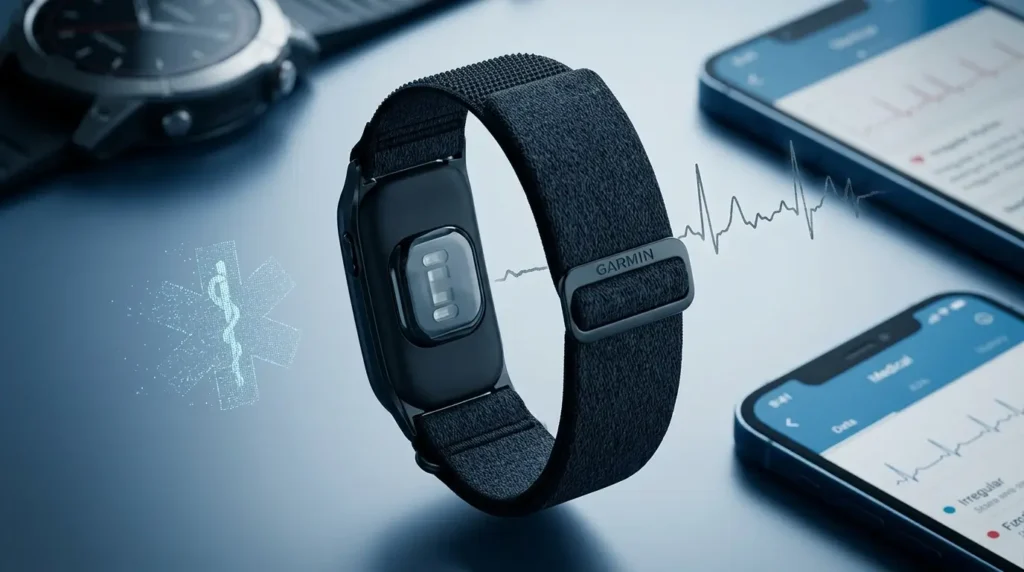
No. The Garmin CIRQA cannot detect atrial fibrillation, and no future firmware update will change that. The Elevate Gen 4 module inside the band lacks the hardware required for ECG or AFib detection.
Key Takeaways
- The CIRQA ships with Garmin’s older Elevate Gen 4 optical sensor, which has no ECG electrodes and therefore no rhythm analysis of any kind.
- Both of its closest rivals cover it: the $99.99 Fitbit Air ships FDA-cleared irregular rhythm notifications, and the Whoop MG adds an on-demand ECG on top.
- Even Garmin’s ECG-equipped watches only run on-demand 30-second tests. No Garmin device offers passive background AFib monitoring.
The Short Answer: No AFib Detection at Any Price Tier
The CIRQA launched on July 24, 2026 at $199.99 with no mandatory subscription. It is a recovery and training band, not a cardiac screening tool.
The pod uses Garmin’s Elevate Gen 4 optical heart rate sensor, and it does not have the sensor hardware or internal wiring to perform medical-grade ECG or AFib detection. There is no manual rhythm check, no background rhythm analysis, and no AFib history log in Garmin Connect.
Garmin’s own product documentation is explicit that the CIRQA is not a medical device and is not intended for diagnosing or monitoring any medical condition.
Why the Gen 4 Sensor Cannot Do It
ECG requires an electrical path across the body, not just an optical one. Optical sensors read blood volume changes through the skin. Electrical rhythm capture needs conductive contacts plus a connecting lead running to the sensor package.
On Garmin watches, the giveaway is a small ring around the edge of the optical sensor on the rear, where the bezel meets the user’s fingers, with a visible connecting wire. The CIRQA has no such ring and no bezel to touch.
A Hardware Limit, Not a Software Gate
Garmin’s position has been consistent since 2023: only watches with the necessary hardware can perform ECGs, and the capability cannot be reverse engineered into existing devices. Garmin says it chose Gen 4 for the CIRQA to keep the module thin.
That decision is harder to defend given the price. Garmin’s own Index Sleep Monitor shipped in June 2025 with the newer Elevate Gen 5, leaving the CIRQA a full sensor generation behind at launch. Anyone weighing the band against subscription alternatives should read our full CIRQA versus Whoop 5.0 breakdown before committing.
What the CIRQA Does Track for Heart Health
The sensor suite is genuinely capable within its limits. The band samples heart rate, heart rate variability, blood oxygen saturation, skin temperature variation and movement, then converts those signals into Body Battery, sleep score, stress, recovery time and training readiness.
The Abnormal Heart Rate Alert Is Not Rhythm Monitoring
One feature does involve heart rate alerts, and it is routinely mistaken for rhythm monitoring. The CIRQA supports Garmin’s Abnormal Heart Rate Alert, configured in Garmin Connect under Notifications and Alerts.
Here is what that alert actually does:
- Fires when resting heart rate crosses a user-set high or low bpm threshold after a period of inactivity
- Delivers the warning as a vibration, since the band has no display
- Measures rate only, never rhythm regularity or waveform morphology
- Does not notify you of any potential heart condition and is not intended to treat or diagnose one
A person in AFib with a controlled ventricular rate would trip no alert at all.
Which Trackers Actually Detect AFib
Two distinct methods exist. On-demand ECG requires you to initiate a 30-second reading. Passive photoplethysmography analyzes rhythm in the background while you are still or asleep, then flags irregularities after sync.
Price Versus Capability
| Device | US Price | AFib Capability |
|---|---|---|
| Fitbit Air | $99.99 | Passive notifications only |
| Fitbit Charge 6 | $159.95 | ECG plus passive notifications |
| Garmin CIRQA | $199.99 | None |
| Apple Watch SE 3 | $249 | Passive notifications, no ECG |
| Whoop MG | $359 per year | ECG plus passive notifications |
| Apple Watch Series 11 | $399 | ECG, passive alerts, AFib History |
| Garmin Venu 3 | $449.99 | On-demand ECG only |
| Garmin Venu 4 | $549.99 | On-demand ECG only |
Samsung’s Galaxy Watch line also pairs FDA-cleared ECG with passive rhythm notifications for Android users. Withings ScanWatch models offer on-demand ECG in a hybrid analog design.
Whoop MG: The Screenless Band That Does Detect It
Whoop is the CIRQA’s closest competitor, and it covers exactly the capability Garmin left out. The Whoop MG includes an FDA-cleared Heart Screener that records an on-demand ECG and delivers Irregular Heart Rhythm Notifications for signs of AFib.
The ECG reading takes roughly 30 seconds with two fingers on the conductive clasp, and the app exports a PDF you can send to a clinician. IHRN runs passively in the background while you rest, so it catches episodes you never feel.
The catch is the business model and the hardware split. Rhythm features require the MG device on the Whoop Life tier at $359 per year, not the standard Whoop 5.0 on One ($199) or Peak ($239). Neither ECG nor IHRN is intended for users under 22 or for those with a pacemaker or ICD.
The pricing inversion is the story. The cheapest screenless band on this list detects AFib, and the most expensive does too. The $199.99 Garmin sits between them with nothing. Our CIRQA versus Fitbit Air comparison covers the rest of that trade.
Whoop is the one screenless band here that actually screens for AFib. If you want to see what your own recovery and rhythm data look like, this referral link gets you a free month to test it properly. I get one too, which helps fund more hardware analysis at Rallynomics.
Who Should Skip the CIRQA Entirely
Skip it if heart rhythm is your reason for buying a wearable at all. That includes anyone with palpitations, an existing arrhythmia diagnosis, a family history of stroke, or a clinician who has asked for rhythm data.
Skip it if you are buying for an older parent. This is the single most common mismatch: the buyer wants an early warning system, and the CIRQA is a training load tracker that happens to read pulse.
Buy it if you already run a Fenix or Forerunner and want 24/7 sleep and recovery capture without wearing a watch to bed. That is the use case Garmin built it for, and it executes well.
No consumer wearable diagnoses AFib. These features flag patterns worth investigating, and only a clinician can confirm what they mean.
FAQ
Not by rhythm. It fires an Abnormal Heart Rate Alert only when your bpm crosses a threshold you set manually, after a stretch of inactivity. Irregular beats within a normal rate range produce no alert.
No. The limitation is physical. Without electrodes and a connecting lead, there is no electrical signal for an algorithm to analyze, and Garmin has confirmed the capability cannot be added retroactively to hardware lacking it.
Yes to both. It costs $99.99 and tracks heart rate, SpO2, sleep stages, HRV and AFib rhythm alerts. Detection is passive, analyzing rhythm data mainly while you are still or asleep, and it offers no manual ECG test. Notifications are unavailable to users under 22 or with an existing AFib diagnosis.
The Venu 2 Plus, Venu 3 series, Venu 4, Fenix 7 Pro and Fenix 8 series, Epix Pro, Enduro 3, Forerunner 970 and Tactix 7 AMOLED. Garmin’s ECG App is FDA-cleared and records a 30-second reading to check for signs of atrial fibrillation. Note that the Vivoactive 6 at $299.99 does not qualify, despite costing more than the CIRQA.