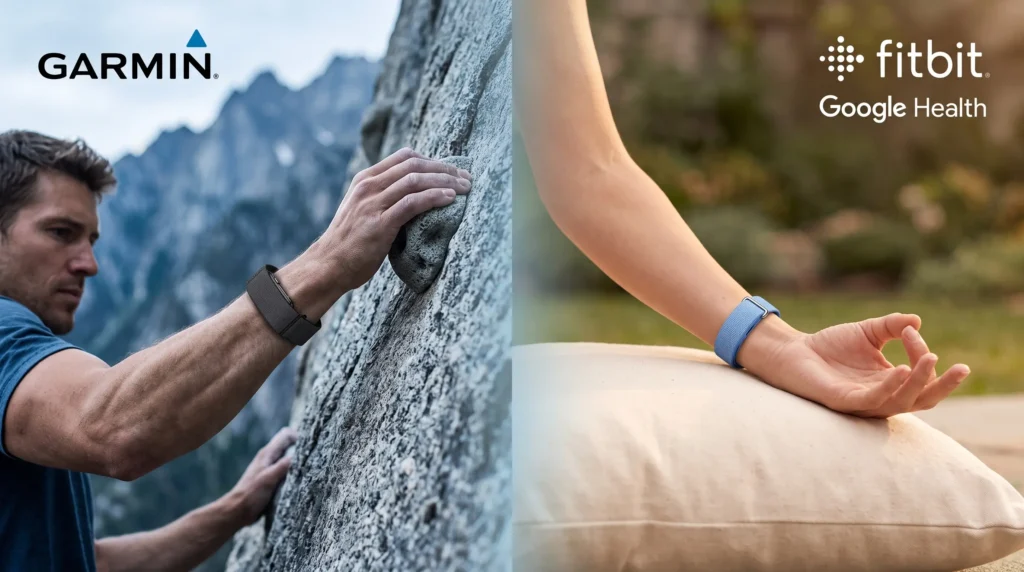
The screenless tracker category has become the most contested corner of the wearables market in 2026. Garmin’s CIRQA Smart Band, announced July 21 and available to order July 24 at $199.99, arrives as a direct challenge to Google’s Fitbit Air, which shipped in late May at $99.99.
Both strip away the display and route every metric into a companion app. The similarity ends at the price tag, and the $100 delta maps almost perfectly onto two different buyer profiles.
Key Takeaways
- Training depth vs. everyday simplicity: CIRQA delivers Garmin’s full training stack (Training Readiness, Body Battery, HRV Status, VO2 max, 80+ activity profiles) with no subscription, while Fitbit Air focuses on accessible core health tracking for casual users.
- Price gap defines the segment: At $99.99, Fitbit Air costs half of CIRQA’s $199.99, weighs 12g against CIRQA’s roughly 20g, and remains the more discreet band for all-day and overnight wear.
- Subscription models diverge: Garmin unlocks its advanced metrics without a paid tier; Fitbit Air’s deeper insights (Google Health Coach, adaptive plans) sit behind a $9.99/month Google Health Premium paywall after the trial.
Two Bands, Two Philosophies
Both devices follow the template popularized by Whoop: a sensor puck seated in a fabric band, worn continuously, with no screen to check. Neither includes onboard GPS, so outdoor route data depends on a paired phone. Both carry a 5 ATM water rating (50 meters) and work with iOS and Android.
Garmin’s approach positions CIRQA as a companion inside its ecosystem rather than a standalone budget play. The band runs an Elevate V4 optical heart rate sensor, the same array used in watches like the Forerunner 170, and it can broadcast heart rate to compatible Garmin devices.
A cyclist can wear it on the upper arm and stream live heart rate to an Edge computer while a Garmin watch handles the workout. That interoperability is the core of Garmin’s pitch: CIRQA can serve as the primary wellness and sleep device while a dedicated watch remains the training tool.
Google’s Fitbit Air targets a wider, more casual audience. At 12g with the band, it is one of the lightest trackers on the market and noticeably slimmer than CIRQA. It leans on the Google Health app and Gemini-powered Health Coach, turning the band into a sensor on-ramp for Google’s broader health platform.
Specification Comparison
| Specification | Garmin CIRQA | Fitbit Air |
|---|---|---|
| Price (US) | $199.99 | $99.99 ($129.99 Stephen Curry edition) |
| Weight (with band) | ~20g | 12g |
| Battery life | Up to 10 days | Up to 7 days |
| Display | None (single side button) | None |
| Water resistance | 5 ATM (50m) | 5 ATM (50m) |
| Heart rate sensor | Elevate V4 optical | Optical + red/IR SpO2 |
| AFib / irregular rhythm alerts | No | Yes |
| Built-in GPS | No (connected GPS) | No (connected GPS) |
| Subscription for advanced features | Not required (optional Connect+) | Google Health Premium ($9.99/mo) |
| Companion app | Garmin Connect | Google Health |
| Compatibility | iOS / Android | Android 11+ / iOS 16.4+ |
Where Each Band Pulls Ahead
CIRQA: Depth Without a Paywall
CIRQA’s strongest argument is the volume of data it surfaces for free. Training Readiness, Body Battery energy monitoring, HRV Status, VO2 max, Sleep Coach, and recovery time are all included through Garmin Connect at no recurring cost. It supports more than 80 sports and activities and improves its automatic activity detection the longer you wear it.
For anyone already invested in Garmin hardware, the ability to designate CIRQA as the primary wearable while keeping a watch as the training device is a genuine functional advantage, not a marketing line.
Fitbit Air: Value and Heart Rhythm Monitoring
Fitbit Air answers with price, weight, and one meaningful health feature CIRQA lacks: passive irregular rhythm notifications with AFib alerts. Neither device offers on-demand ECG, but only the Air actively watches for signs of atrial fibrillation.
At half the cost and lighter on the wrist, it is the easier band to forget you are wearing, which matters most during sleep tracking. The tradeoff is the subscription gate: core tracking is free, but adaptive fitness plans and the Health Coach require Google Health Premium after the bundled trial.
Which One Fits Your Wrist
The decision resolves cleanly. Buy the CIRQA if you want deep training analytics without a monthly fee, longer battery life, and integration with existing Garmin devices. It suits athletes and data-driven users who treat recovery metrics as actionable inputs.
Buy the Fitbit Air if you want an affordable, ultralight band for everyday health monitoring, value heart rhythm alerts, and are comfortable with a subscription for the more advanced coaching layer. For a casual user tracking sleep, steps, and general wellness, the Air delivers most of the value at half the outlay.
Both bands reflect a broader shift toward distraction-free wearables. If you are weighing this category against a full smartwatch, our roundup of the best high-end smartphones of 2026 covers the on-device AI health features that increasingly overlap with dedicated trackers.
FAQ
No. CIRQA delivers its full set of health and training metrics, including Training Readiness and Body Battery, through Garmin Connect without a required subscription. Garmin offers an optional Connect+ tier, but the core experience is free.
The Garmin CIRQA leads with up to 10 days per charge, compared to up to 7 days for the Fitbit Air. The Air offsets this with a 5-minute fast charge that provides roughly a full day of use.
Not for GPS route data. Neither the CIRQA nor the Fitbit Air has built-in GPS. Both rely on connected GPS, meaning you must carry a paired phone to record distance, pace, and route during outdoor activities.
Yes. The Fitbit Air supports passive irregular rhythm notifications with AFib alerts, a feature the Garmin CIRQA does not include. Neither device offers on-demand ECG readings.