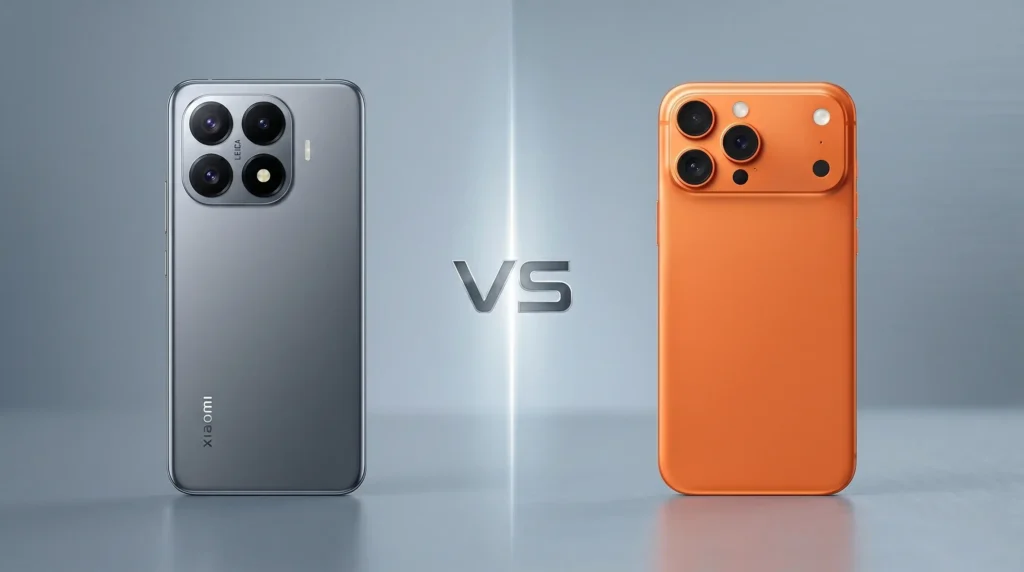
Xiaomi 17T Pro and the iPhone 17 Pro Max are the two most debated flagship handsets of 2026. The former, priced at $899, delivers a 7,000 mAh silicon-carbon battery and Leica-certified imaging.
The latter, at $1,199, justifies its premium with the most capable video system on the market and an unmatched hardware ecosystem. $300 delta defines the decision — but price is only one variable.
What You Need to Know Before Choosing
Disruptive battery technology: The Xiaomi 17T Pro introduces a 7,000 mAh silicon-carbon cell with 100W wired charging, fundamentally redefining endurance at the flagship tier without expanding the device’s physical footprint.
Divergent imaging philosophies: Xiaomi commits to the Leica aesthetic — organic tones, pronounced shadow detail, restrained post-processing — while the iPhone 17 Pro Max consolidates its position as a professional video production tool, with ProRes RAW capture and 48 MP sensors across all three modules.
The real price gap: At $899, the Xiaomi 17T Pro applies direct pressure to the iPhone’s $1,199 positioning. However, perceived value within the enthusiast community has eroded somewhat compared to earlier T-series generations.
Xiaomi 17T Pro vs iPhone 17 Pro Max: Full Specifications
| Component | Xiaomi 17T Pro | iPhone 17 Pro Max |
|---|---|---|
| Display | AMOLED 6.83″ / 144 Hz / 3,500 nits | LTPO OLED 6.9″ / 120 Hz / 3,000 nits |
| Processor | MediaTek Dimensity 9500 (3 nm) | Apple A19 Pro (3 nm) |
| RAM | 12 GB LPDDR5X | 12 GB |
| Storage | 256 GB – 1 TB (UFS 4.1) | 256 GB – 2 TB (NVMe) |
| Main camera | 50 MP / f1.6 / OIS / 23 mm | 48 MP / f1.78 / OIS / 24 mm |
| Telephoto | 50 MP / f3.0 / 5x optical / 115 mm | 48 MP / f2.8 / 4x optical / 100 mm |
| Ultra-wide | 12 MP / f2.2 / fixed focus | 48 MP / f2.2 / OIS |
| Front camera | 32 MP / f2.2 | 18 MP / f1.9 / quad-pixel sensor |
| Battery | Silicon-carbon 7,000 mAh | Li-ion 5,088 mAh |
| Fast charging | 100W wired / 50W wireless | 40W wired / 25W MagSafe |
| Software | Android 16 + HyperOS 3 | iOS 26 |
Note: The global 17T Pro variant uses the MediaTek Dimensity 9500 and a conventional flat-frame design. The Xiaomi 17 Pro Max — featuring a secondary rear display and Snapdragon silicon — is distributed exclusively within China and shares no specifications with the device reviewed here.
Design and Display
The iPhone 17 Pro Max breaks from the established square camera module format. It adopts a full-unibody aerospace aluminium chassis with a horizontal rear “camera plateau” and new colour options including Cosmic Orange — a meaningful visual departure for a line that had remained largely unchanged in design language for several years.
The Xiaomi 17T Pro opts for an aluminium frame with a reinforced fibreglass rear panel. At 8.25 mm thick and 219 g, it sits in comparable territory to the iPhone in terms of form factor, resists fingerprint accumulation well, and maintains a restrained aesthetic profile.
On paper, the Xiaomi’s display holds a clear advantage: 144 Hz, 3,500 nit peak brightness, 3,840 Hz PWM dimming, and a 1 nit minimum for low-light reading. The key limitation: without LTPO, the minimum refresh rate floors at 30 Hz rather than the 1 Hz adaptive floor Apple achieves.
Apple counters with Ceramic Shield 2 and a superior anti-reflective coating, delivering noticeably better performance in direct sunlight conditions.
Performance and Endurance: Dimensity 9500 vs A19 Pro
Both chips are manufactured on 3 nm processes, and neither leaves meaningful questions about raw processing capacity. The A19 Pro benefits from a vapour chamber integrated directly into the aluminium chassis, with Apple reporting a 40% improvement in sustained performance under extended workloads — particularly relevant for gaming sessions and video editing pipelines.
The Dimensity 9500 has addressed MediaTek’s historical weaknesses under sustained multi-threaded load. HyperOS 3 delivers fluid responsiveness throughout, though background process management limits real-world endurance to just under a day and a half under intensive use — a consideration worth holding against what is this device’s headline specification.
On the silicon-carbon battery technology itself: the chemistry achieves greater energy density without increasing cell volume. The result is 7,000 mAh in an 8.25 mm chassis. 100W wired charging fills that capacity at a rate that makes “carrying a charger” an essentially redundant concern.
The iPhone, equipped with up to 5,088 mAh and 40W charging, remains competitive in day-to-day endurance due to iOS’s power efficiency architecture — but the charging speed differential is objectively substantial.
Camera Systems: Leica Imaging vs Apple’s Video Platform
Xiaomi-Leica partnership produces images with a distinct identity: natural colour rendering, pronounced shadow rolloff, and organic post-processing that avoids the over-sharpened output common across the broader industry. The 5x periscope telephoto (115 mm) is particularly strong in sharpness and portrait mode fidelity. The system’s weak point is the 12 MP fixed-focus ultra-wide, which underperforms in low-light environments.
Apple has constructed a more technically uniform system. The ultra-wide advances to 48 MP with autofocus (enabling macro capture), the tetraprism telephoto achieves effective 8x zoom quality through sensor-crop methodology, and the 18 MP front camera with its quad-pixel sensor allows content creators to maintain consistent framing orientation during portrait-to-landscape rotation without repositioning.
For professional video production workflows, the iPhone retains clear leadership: ProRes RAW capture, Log colour profiles, and a post-production ecosystem no Android manufacturer currently matches. One engineering decision has generated notable debate: Apple removed the dedicated Night Portrait mode in this generation, a consequence of the 48 MP tetraprism sensor redesign.
For broader context on how different manufacturers are resolving the tension between manual imaging control and AI-driven automation, the Sony Xperia 1 VIII vs Samsung Galaxy S26 Ultra comparison provides useful reference points.
Pricing and Value: Is the iPhone 17 Pro Max Worth $300 More?
At $899, the Xiaomi 17T Pro no longer occupies the clear value-proposition territory that defined earlier T-series generations. The enthusiast community has been consistent on this point: the price differential between the global 17T Pro and grey-market variants of the Xiaomi 17 Pro Max from the primary line weakens the cost argument.
Two specification gaps carry meaningful weight in the analysis. The absence of a UWB (Ultra-Wideband) transceiver limits integration with precision-tracking accessories. And Android’s app ecosystem continues to trail iOS in the depth and quality of professional creative productivity tooling.
The iPhone 17 Pro Max at $1,199 justifies its price ceiling within specific use-case verticals: professional video production, tight Apple ecosystem integration, resale value retention, and guaranteed long-term software support. For users whose workflows fall outside those parameters, the $300 premium is a harder case to make.
Understanding how the broader mobile market is fragmenting in 2026 provides useful context for why these decisions have become increasingly personal rather than universal.
Verdict: Xiaomi 17T Pro or iPhone 17 Pro Max in 2026?
Choose the Xiaomi 17T Pro if: your primary requirements are real-world battery endurance, charging speed, and imaging with a distinctive artistic character. It is also the stronger option if you have no dependency on the Apple ecosystem or professional video production capabilities.
Choose the iPhone 17 Pro Max if: you require the most capable video system currently available, you are already invested in the Apple ecosystem, or you prioritise long-term software support consistency above any individual hardware specification.
Frequently Asked Questions: Xiaomi 17T Pro vs iPhone 17 Pro Max
No. The global 17T Pro uses a conventional flat rear panel. The 2.9-inch secondary display is exclusive to the Xiaomi 17 Pro Max, which is sold primarily in Asian markets.
Yes. The chemistry delivers greater energy density within a smaller physical volume. The Xiaomi 17T Pro achieves that capacity without increasing chassis thickness or introducing additional safety risks compared to conventional lithium cells.
The redesign of the tetraprism telephoto to a 48 MP sensor introduced architectural changes to both the sensor and aperture configuration that made the feature incompatible with the native Camera app in this generation.
No. The device does not include a UWB transceiver. The iPhone 17 Pro Max incorporates a second-generation UWB chip for precision spatial tracking of compatible accessories.