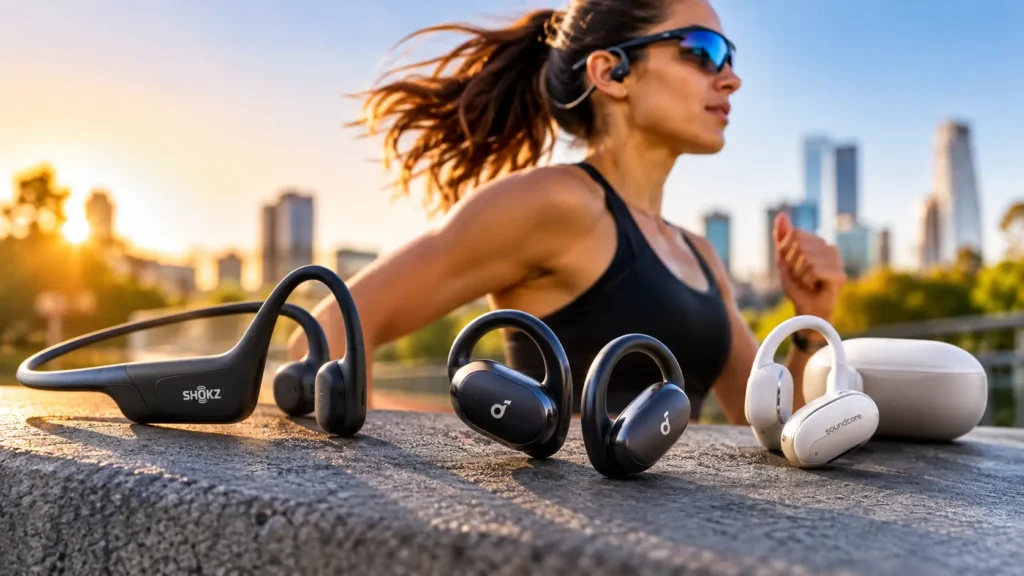
Open-ear earbuds solve the core problem of running with audio on public roads: you keep your music and still hear the car behind you. The catch is that fit, sound leakage, and bass vary far more across this category than across sealed earbuds.
This guide covers the US-available models that stay in place at running cadence, how bone conduction differs from air-conduction open-ear designs, and which battery ratings hold up over a marathon.
Some links on this page are affiliate links. If you buy through them, Rallynomics receives a commission at no extra cost to you.
Key Takeaways
- Shokz OpenRun Pro 2 ($179.95) is the safest default for road running: a one-piece bone conduction frame that leaves both ear canals fully open and delivers 12 hours per charge.
- Shokz OpenFit Pro ($249.95) adds open-ear noise reduction for loud urban routes, but enabling it cuts battery life from 12 hours to 6.
- Under $100, the Soundcore AeroFit 2 brings adjustable hooks and 10 hours per charge, while the Shokz OpenMove ($79.95) is the cheapest way into bone conduction.
Open-Ear vs Bone Conduction for Runners
Both designs keep the ear canal unsealed. The difference is the path sound takes to reach the inner ear.
- Bone conduction: transducers rest on the cheekbones in front of the ear and transmit vibration through bone.
- Air-conduction open-ear: a small speaker sits just outside the ear canal and projects sound toward it.
- Hybrid: the OpenRun Pro 2 pairs a bone conduction driver for mids and highs with an air-conduction driver for bass, which reduces the vibration older bone conduction models produced at high volume.
What each design means on the road
Bone conduction leaves the entire outer ear free, so ambient sound reaches you without obstruction. The cost is lighter bass and a rear headband that can clash with some hats and hydration vests.
Air-conduction buds sound fuller and weigh less per side. They also ship with a charging case, which means more total battery but one more thing to carry and lose.
| Design | Example | Ear canal | Bass | Weight |
|---|---|---|---|---|
| Hybrid bone conduction | Shokz OpenRun Pro 2 | Fully open | Moderate | 30.3 g total |
| Bone conduction | Shokz OpenMove | Fully open | Light | 29 g total |
| Air-conduction open-ear | Shokz OpenFit 2+ | Open | Full | 9.4 g per bud |
| Open-ear with noise reduction | Shokz OpenFit Pro | Open | Fullest | 12.3 g per bud |
Best Overall for Road Running: Shokz OpenRun Pro 2
The OpenRun Pro 2 is the model to buy if hearing traffic is the priority. At $179.95, it combines full ear-canal awareness with the strongest bass Shokz has fitted to a bone conduction frame.
SHOKZ OpenRun Pro 2 Bone Conduction Bluetooth Sport Headphones
Price: $179.95
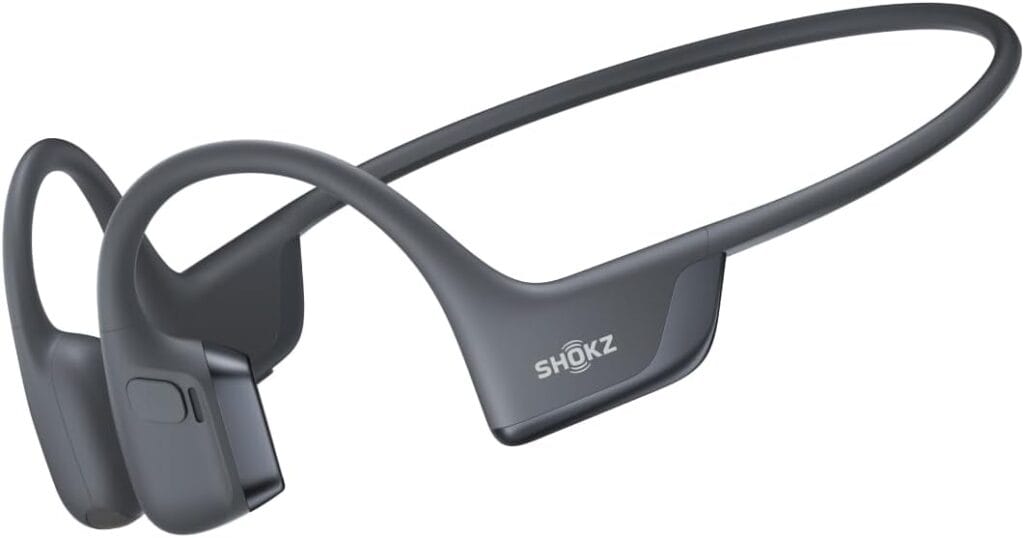
- Battery: up to 12 hours per charge
- Quick charge: 5 minutes for 2.5 hours of playback
- Protection: IP55
- Weight: 30.3 g (a Mini size is also available)
- Connectivity: Bluetooth 5.3 with multipoint
- Charging: USB-C, replacing the proprietary magnetic cable of the first OpenRun Pro
Why a one-piece frame suits traffic
A wraparound nickel-titanium band has no loose bud to drop onto the asphalt. If it shifts, it stays on your head rather than falling to the curb.
Physical buttons on the frame are also easier to operate with sweaty fingers than the touch panels common on true wireless buds.
Where it falls short
There is no charging case, so 12 hours is the ceiling until you reach a USB-C cable. Bluetooth 5.3 is a generation behind the newest Shokz buds, and IP55 means it handles sweat and rain but not submersion.
The true wireless alternative: Shokz OpenFit 2+
If you prefer separate buds, the OpenFit 2+ ($199.95) weighs 9.4 g per side, runs 11 hours per charge, and reaches 48 hours with the case. It adds Qi wireless charging and Dolby Audio, though enabling Dolby Audio costs roughly 2 hours of playback.
Best Open-Ear With Noise Reduction: Shokz OpenFit Pro
The OpenFit Pro is the first Shokz open-ear model with active noise reduction. Launched in January 2026 at $249.95, it is the most expensive pair in the Shokz lineup.
A three-microphone array, including a feedback mic, generates inverse sound waves to lower background noise without sealing the ear. Expect a noticeable cut in low-frequency noise such as engine rumble and wind, not the near-silence of sealed ANC buds.
SHOKZ OpenFit Pro Open-Ear Earbuds – Noise Reduction – Dolby Atmos
Price: $199

- Battery: 12 hours with noise reduction off, 6 hours with it on
- With case: 50 hours (24 hours with noise reduction on)
- Quick charge: 10 minutes for 4 hours
- Protection: IP55
- Weight: 12.3 g per bud
- Extras: Bluetooth 6.1, multipoint, Qi wireless charging, Dolby Atmos with head tracking
The running trade-off
Noise reduction works against the reason runners choose open-ear audio. The practical approach is to enable it on noisy commutes or treadmill sessions and disable it on open roads, where the noise level is also adjustable in the Shokz app.
The OpenFit Pro is also heavier than the OpenFit 2+ (12.3 g vs 9.4 g per bud), and its ear hook is not adjustable. If you want full sealed ANC for gym and commute use instead, our AirPods 5 vs AirPods Pro 3 comparison covers the in-ear side of that decision.
The dual-form alternative: Soundcore AeroFit 2 Pro
At $179.99, the AeroFit 2 Pro switches between an open-ear position and a sealed in-ear position with ANC. Battery is shorter: 7 hours open, 5 hours in ANC mode.
In sealed mode your ear canal is blocked, so treat it as a gym and commute setting, never a road setting.
Best Budget Pick Under $100
Two models deliver real running utility below $100, and they represent the two designs covered above.
| Spec | Soundcore AeroFit 2 | Shokz OpenMove |
|---|---|---|
| Design | Air-conduction open-ear | Bone conduction |
| Price | Under $100 on Amazon US | $79.95 list |
| Battery | 10 h / 42 h with case | 6 h |
| Protection | IP55 | IP55 |
| Weight | About 10 g per bud | 29 g |
| Controls | Touch | Physical buttons |
| Extras | LDAC, wireless charging, multipoint | Multipoint, USB-C |
Soundcore AeroFit 2
The AeroFit 2 launched at $99.99 and routinely sells below $100 on Amazon US, although Soundcore’s own US store now lists it higher. Its multi-position ear hooks adjust to different ear sizes, a key advantage at this price.
The weak point for running is touch controls, which are less reliable with sweat or gloves than physical buttons.
Shokz OpenMove
The OpenMove is the cheapest Shokz model and is frequently discounted below its $79.95 list price. Six hours covers most training runs, but there is no quick charge and a full charge takes 2 hours.
Choose it for runs under two hours where full ear-canal awareness matters more than bass.
Fit and Sweat Resistance Compared
Rallynomics has not run a controlled 10K retention test on these models, so this comparison relies on retention design and certified ratings rather than drop counts. Those two factors still separate the field clearly.
| Model | Retention | Rating | Controls | Sizes |
|---|---|---|---|---|
| Shokz OpenRun Pro 2 | Wraparound band | IP55 | Buttons | Standard, Mini |
| Shokz OpenFit Pro | Fixed ear hook | IP55 | Button | One size |
| Shokz OpenFit 2+ | Flexible ear hook | IP55 | Buttons | One size |
| Soundcore AeroFit 2 | Adjustable ear hook | IP55 | Touch | Adjustable |
| Soundcore AeroFit 2 Pro | Adjustable ear hook | IP55 | Touch | Adjustable |
| Shokz OpenMove | Wraparound band | IP55 | Buttons | One size |
What IP55 actually covers
Every pick here is rated IP55: protected against dust and low-pressure water jets from any direction. That handles sweat and rain, but not submersion.
- Wipe sweat off charging contacts before closing the case.
- Charging cases are generally not water resistant, so keep them out of a wet pocket.
- For runners who train in heavy rain, the standard Shokz OpenRun ($129.95) carries an IP67 rating.
Which retention design stays put
Wraparound bands are the most forgiving at high cadence because the load is spread across the back of the head. Adjustable hooks are the next safest choice for smaller or larger ears that a one-size hook may not grip securely.
Battery for Long Runs and Races
Manufacturer battery ratings are measured at moderate volume with extra audio features off. Louder playback, spatial audio, and noise reduction all shorten real runtime.
| Model | Per charge | With case | Quick charge |
|---|---|---|---|
| Shokz OpenRun Pro 2 | 12 h | No case | 5 min = 2.5 h |
| Shokz OpenFit Pro | 12 h (6 h NR on) | 50 h (24 h NR on) | 10 min = 4 h |
| Shokz OpenFit 2+ | 11 h | 48 h | 10 min = 2 h |
| Soundcore AeroFit 2 | 10 h | 42 h | Not specified |
| Soundcore AeroFit 2 Pro | 7 h (5 h ANC) | 34 h (24 h ANC) | Not specified |
| Shokz OpenMove | 6 h | No case | None |
Planning around your longest effort
Plan for a single charge to cover at least 1.5 times your expected finish time. A five-hour marathon fits comfortably within every model here except the OpenMove and the OpenFit Pro with noise reduction enabled, both of which leave little margin.
For ultras and long trail days, only the 11 to 12 hour models make sense, since a case is useless mid-route.
Pair audio with the right tracker
Open-ear audio pairs well with minimal wrist hardware on long efforts. If you want training data without another screen competing for attention, see our guide to the best screenless fitness trackers in 2026.
FAQ
They are safer than sealed earbuds because the ear canal stays open to traffic, horns, and cyclists. Safety still depends on volume: at high levels, any audio can mask quieter cues. Keep volume moderate and turn off noise reduction on roads.
Yes, some sound escapes because the speaker is not sealed against the ear. Leakage rises with volume, and models like the OpenFit Pro use directional drivers and a privacy-focused EQ mode to reduce it.
The OpenRun Pro 2 is the better pure running tool: it leaves both ear canals fully open, costs $70 less, and cannot drop a bud. The OpenFit Pro sounds better, adds noise reduction, and offers 50 hours with its case, making it the stronger choice if the same pair also covers commuting and office use.
Usually, but it depends on the event. USA Track & Field amended its rules in 2008 to allow listening devices in non-championship races, while athletes competing for awards or prize money remain restricted. Each race sets its own policy, so check the athlete guide before race day.